
Portrait of a Cape Weaver
On 18 October 2014 I ringed a juvenile Cape Weaver at the wetland at Diep River (Elfindale) in Cape Town, caught with 44 other birds that morning. A year...
News about Weaver research
On 18 October 2014 I ringed a juvenile Cape Weaver at the wetland at Diep River (Elfindale) in Cape Town, caught with 44 other birds that morning. A year...
PHOWN, PHOtos of Weaver Nests, is a Virtual Museum, citizen science project at the University of Cape Town, to collect and monitor breeding distributions and co...
Weavers usually nest on trees, in reeds or grass. Increasingly, some weaver species are also nesting on man-made structures. Some of the main structures ...
Weaver nests are often very conspicuous, as males (in polygynous species) try to attract more females. This means that the nests are also more visible to predat...
Many birds bathe to help clean their feathers, but some species do not seem to bathe. Species that often bathe include thrushes, bulbuls, babblers, finch...
Anting is when birds apply ants to their plumage. Birds select ants in the subfamily Formicinae, which produce formic acid when disturbed. Formic acid is toxic ...
Oschadleus HD 2020 Variation in colony sizes of weavers from a citizen science project. Ostrich online Download a pdf of the paper here (limited to 50 copies,...
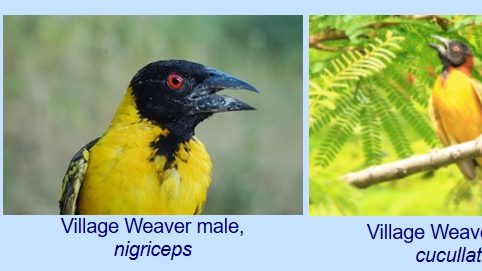
Over 600 names have been proposed for weaver species and subspecies, but many of these names are taxonomically invalid. There are 117 weaver bird species, but d...
Weaver identification, ageing & sexing Papers from Safring News General Oschadleus HD. 2011. Iris colours in ageing and sexing South African Ploceus weavers...
The Red-necked Falcon Falco chicquera eats mostly small to medium-sized birds, usually less than 300 g in weight. It also preys on small mammals (like bats and ...