
Weaver species list / RELATED SPECIES: Fan-tailed Widowbird / Jackson’s Widowbird / Long-tailed Widowbird / Marsh Widowbird / Mountain Marsh Widowbird / White-winged Widowbird / Yellow Bishop / Yellow-mantled Widowbird
IUCN: Least concern Discovery: 075
Categories: long tail, fruit
Discovery
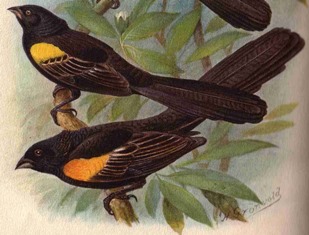 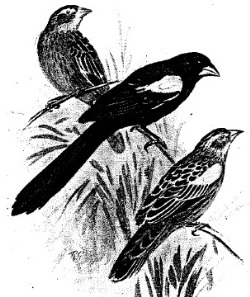 
IntroductionThe Marsh Widowbird was formally described by Jose Vicente Barbosa du Bocage, a Portuguese zoologist and politician. He was curator of the Lisbon Museum, and described several other weavers.The Marsh Widowbird was collected by Jose Alberto de Oliveira Anchieta, a Portuguese explorer and naturalist, who collected a large number of birds in Angola. In 1867 the Portuguese government hired Anchieta as a naturalist but probably also as a secret agent and informer in the Caconda region of Angola. Anchieta lived in Caconda, explored the area and sent many specimens and letters to his scientific correspondents in Lisbon. Anchieta discovered the Marsh Widowbird near Caconda, and sent a single male specimen to the Lisbon Museum. Bocage measured the tail as 160 mm, while tail length in the nominate subspecies is usually 163-201 mm. The first illustration of the Marsh Widowbird was published in Delacour (1933). The second illustration was published by Bannerman (1949), as a black and white sketch, but also showing the female and non-breeding male. Scientific citationPenthetria hartlaubi Bocage 1878 Jorn. Sci. Math. Phys. Nat. Lisboa, 6, p.259 Caconda, Angola. Meaning of nameshartlaubi, After Karl Johann Gustav Hartlaub (1814-1900) German ornithologist and author. First English nameHartlaub’s Widow Bird (Layard 1884). Alternate namesHartlaub’s Marsh Whydah, Hartlaub’s Marsh Widowbird, Marsh Whydah, Uganda Marsh Whydah. CollectorJose de Anchieta. Date collectedBefore 1878. Locality collectedCaconda, Angola. Type specimensThe type specimen was in the Museum of Lisbon, before a fire destroyed the museum. |
The above is based on Weaver Wednesday 2, a weekly series about the discovery of each weaver species.
This species text first appeared as Weaver Wednesday [192] – Discovery [75]: Marsh Widowbird on 2016-02-17
1. Basic biology
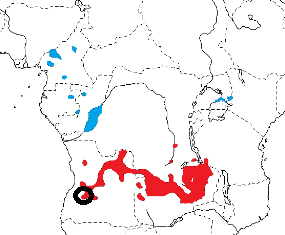
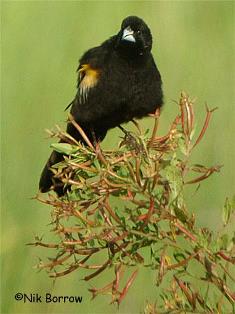 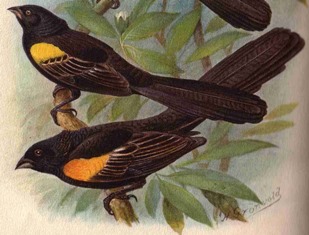 Identification. The Marsh Widowbird breeding male is black with a long tail, white bill, and yellow or orange and buff shoulder patches. The patches resemble those of the Fan-tailed Widowbird but the tail is longer in the Marsh Widowbird.In Kenya the similar Yellow-mantled Widowbird has yellow epaulets while these are orange in the Marsh Widowbird, and further south the Yellow-mantled Widowbird is distinguished by a yellow mantle. The non-breeding male Marsh Widowbird is dull with coloured epaulets and dark wings. The female is dull with a dusky underwing and buff underparts. Distribution. Two subspecies of the Marsh Widowbird are recognised (see map above, based on Birds of Africa): Habitat. The Marsh Widowbird inhabits swampy grasslands and nearby cultivated areas. It may visit deeper water in reeds, perching on floating lily leaves or other floating vegetation. Food. The Marsh Widowbird feeds on grass seeds, insects including grasshoppers and small fruit and berries. It usually forages in small groups, often with other widowbirds. Breeding. The Marsh Widowbird is polygynous. The nest is spherical, with a side entrance. The male builds the outer frame of the nest, using fine grass stems and incorporating living grass, which forms a bower over the nest. The female adds lining of dry grass, and continues to add lining after the first eggs have been laid. The nest is placed low down, usually within 20 cm of the ground, in wet areas with dense grass. The clutch is 1-3 eggs, which are pale greenish-blue or olive-green, marked with spots and blotches. There is no other information on breeding. |
The above is based on Weaver Wednesday, a weekly series about weaver species.
This species text first appeared as Weaver Wednesday [106]: Marsh Widowbird on 2014-06-25
2. Breeding facts
| Pair bond Polygynous Breeding season Nest site Nest building Colony size Clutch size Egg colour Egg size Incubation Chicks and nestling period |
Breeding information based on Handbook of the Birds of the World, Vol. 15.
3. Photos of Weaver Nests
No records yet – be the first to submit a PHOWN record!
4. Voice
Contact call is a loud metallic buzzing ‘wrrng’ or ‘drrrt’. rising slightly in pitch – this call is distinct compared to other widows and bishops. The song may consist of calls, followed by a high-pitched buzz or trill, “chrrrrrritterweeeeeeee”.
Updated text 12/10/2023