
Weaver species list / RELATED SPECIES: Fan-tailed Widowbird / Jackson’s Widowbird / Long-tailed Widowbird / Marsh Widowbird / Mountain Marsh Widowbird / White-winged Widowbird / Yellow Bishop / Yellow-mantled Widowbird
IUCN: Least concern Discovery: 050
Categories: , nectar, pest, blue-billed widows
Discovery
 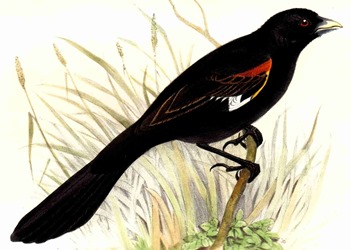 
IntroductionThe White-winged Widowbird was formally described by John Cassin, an American ornithologist.The White-winged Widowbird was collected by Jules Pierre Verreaux, a French botanist and ornithologist. Jules and his brothers were professional collectors of and traders in natural history specimens, who worked in South Africa and other parts of the world. The White-winged Widowbird specimens are labelled as Port Natal (Durban) and Cap. de B. Esp. (the Cape – Jules Verreaux worked at the South African Museum for several years, but the species would have been collected north of the Cape). Unfortunately, the Verreaux brothers did not usually keep good records on localities and dates of where specimens were collected. Although the precise collection locality is not certain, Durban is adequate as a type locality for the White-winged Widowbird. White-winged Widowbird specimens were sent to the Verreaux business in Paris where Edward Wilson [see Stone 1899 p6] obtained 3 of the widow specimens to take to the Academy of Natural Sciences of Drexel University, formerly the Academy of Natural Sciences of Philadelphia (ANSP), the oldest natural science research institution and museum in the New World. Cassin was curator of the Philadelphia Academy of Natural Sciences and he described many species of bird as they arrived at the museum. The first illustration of a White-winged Widowbird is a colour painting published by Cassin 1849. The second illustration was published by Hartlaub 1863, of the subspecies eques that was collected by John Hanning Speke. Scientific citationVidua albonotata Cassin 1848 Proc. Acad. Nat. Sci. Philad., p65 Port Natal = Durban, KwaZulu-Natal. Meaning of namesalbonotata/albonotatus – Latin albus, white; notatus, marked (notare, to mark). First English nameThe white-shouldered Widow (Reichenbach 1863). Alternate namesAngola White-winged Whydah, Cinnamon-shouldered Widowbird, East African White-winged Whydah, The white-shouldered Widow, White-fronted Widow-Bird, White-winged Whydah. CollectorJules Verreaux. Date collectedLong before 1848, but date unknown. Locality collectedPort Natal = Durban. Type specimensANSP 14224, ANSP 14225 and ANSP 14226 in Academy of Natural Sciences of Drexel University. |
The above is based on Weaver Wednesday 2, a weekly series about the discovery of each weaver species.
This species text first appeared as Weaver Wednesday [167] – Discovery [50]: White-winged Widowbird on 2015-08-26
1. Basic biology
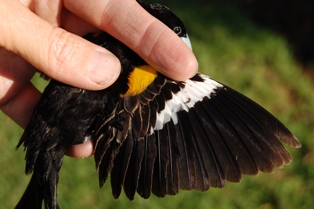 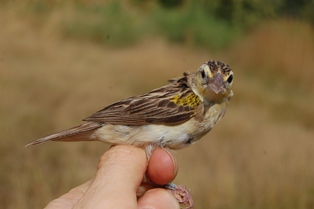 Identification. The White-winged Widowbird is a small widowbird with a fan-shaped tail. The male in breeding plumage is black with a white wing-patch and wing edgings, and white underwing; in southern African birds the epaulet (shoulder patch) is yellow (above), while in East African birds it is cinnamon-rufous. Females (above) and non-breeding birds may be identified in flight by the longish tail, white and yellow/rufous wing patches, and white underwing. Distribution. The White-winged Widowbird is common in East and south-east Africa (see map below), based on Birds of Africa). Three subspecies are currently recognised: E. a. albonotatus in eastern South Africa, north-east Botswana and Namibia, to southern Tanzania (intergrading with eques around Iringa and Dodoma) (see red on map above). E. a. asymmetrurus found patchily from western Angola to western Gabon, and Sao Tome (see blue on map). The tail of breeding males is much larger in this subspecies. E. a. eques from southern Tanzania to southern Sudan and Ethiopia with isolated populations in western Sudan and Central African Republic (see green on map). Breeding males have cinnamon-brown (not yellow) epaulets, and females and sub-adult males have the lesser coverts edged with cinnamon. The White-winged Widowbird established a breeding population from escapees in the Sydney area in Australia, but apparently was extinct there by 1976. This species has shown a substantial range expansion in the Free State Province of South Africa since the 1990s. Ornithologists in the Free State attribute this to increased rainfall (see maps and report here). Habitat. The White-winged Widowbird occurs in tall bushed grassland, generally below 2000m.  Food. The White-winged Widowbird feeds on grass seeds, nectar of Aloe marlothii, and insects, including termite alates. It feeds on millet in some areas and is sometimes a minor pest. The White-winged Widowbird catches termites on the ground or hawks them in the air, returning to a perch to eat them. Breeding. This species is polygynous, with up to 4 females per male. The nest is oval with a large side entrance. The male builds the nest frame of dry and semi-green grass, supported by upright grass stems. The female adds a stouter weaving of finer dry grass, usually Sporobolus, inside the frame. Some nests have a small porch of projecting grassheads. Nests are usually sited below 1.5 m. Eggs may be laid before the nest is lined. Only the female incubates and feeds the nestlings, mainly by regurgitation. Nests are sometimes parasitized by the Diederik Cuckoo. Old nests may be used by Orange-breasted (Zebra) Waxbills. |
The above is based on Weaver Wednesday, a weekly series about weaver species.
This species text first appeared as Weaver Wednesday [22]: White-winged Widowbird on 2012-11-14
2. Breeding facts
| Pair bond Polygynous, with up to four females per male Breeding season Nest site Nest building Colony size Clutch size Egg colour Egg size Incubation Chicks and nestling period |
Breeding information based on Handbook of the Birds of the World, Vol. 15.
3. Photos of Weaver Nests
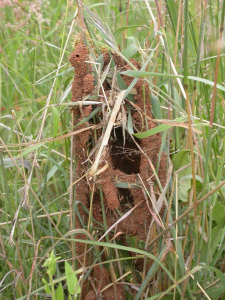 Vm 19022 |
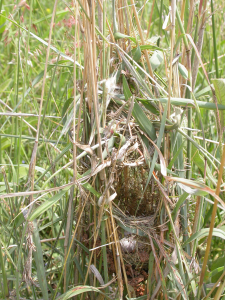 Vm 19021 |
 Vm 8635 |
 Vm 8520 |
Vm 1032 |
Thumb-nails of recent PHOWN records