
Weaver species list / RELATED SPECIES: Chestnut-crowned Sparrow-Weaver / Chestnut-mantled Sparrow-Weaver / Donaldson-Smith’s Sparrow-Weaver / Rufous-tailed Weaver / White-browed Sparrow-Weaver
IUCN: Least concern Discovery: 088
Categories: Plocepasser, cooperative
Discovery
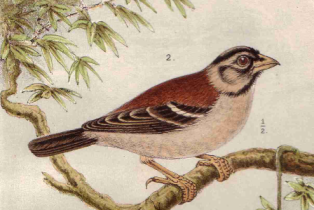
IntroductionThe Chestnut-mantled Sparrow-Weaver was formally described by Dr Johann Buttikofer, a Swiss zoologist. Buttikofer undertook two zoological expeditions to the Republic of Liberia, so he had some experience of African birds.The Chestnut-mantled Sparrow-Weaver was collected by Pieter Jacob van der Kellen, a Dutch naturalist, collector and explorer in southern Angola, who was working for the Dutch Natural History Museum in Leiden. Van der Kellen took part in the Dutch Ethnographic Museum’s South West Africa (=Angolan) expedition (1884-1885), and stayed on in Angola until 1888. His job was to act as a hunter and to search for and collect ‘interesting’ animals. Van der Kellen visited the Kasinga River four times, the first two trips being in December 1886 and January 1887. It was only on the third visit (27 February – 11 March 1887) that he collected the Chestnut-mantled Sparrow-Weaver. The first illustration of the Chestnut-mantled Sparrow-Weaver was of the male type specimen, published by Buttikofer (1888). The next illustration to be published was some 6 decades later in Chapin (1954). Scientific citationPlocepasser rufoscapulatus Buttikofer 1888, Notes Leyden Mus. 10, p.238, pl. 9 Kasinga River, southern Angola. Meaning of namesrufoscapulatus, Latin: rufus, red; scapulae, the shoulders; -atus, possessing. First English nameRed-backed Weaver Bird (Stark 1900). Alternate namesChestnut-backed Sparrow Weaver, Red-backed Weaver Bird, Red-mantled Sparrow-Weaver, Rufous-backed Sparrow Weaver. CollectorPieter Jacob van der Kellen. Date collected27 February 1887. Locality collectedKasinga River, Angola. Type specimensThe type is in the Leiden Museum (RMNH_90361). |
The above is based on Weaver Wednesday 2, a weekly series about the discovery of each weaver species.
This species text first appeared as Weaver Wednesday [205] – Discovery [88]: Chestnut-mantled Sparrow-Weaver on 2016-05-17
1. Basic biology
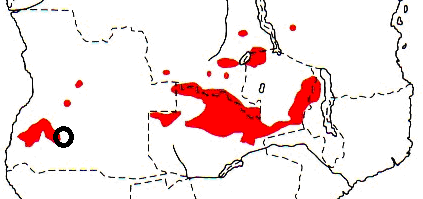
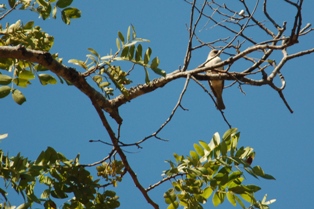 Identification. The Chestnut-mantled Sparrow-Weaver, or Chestnut-backed Sparrow-Weaver, is a large sparrow-like weaver with heavy black and white head stripes and chestnut back and 2 white wing-bars. The bill is usually white in the male, and black in the female, but this is variable. Its miombo habitat further helps separate it from the White-browed Sparrow-weaver where their ranges meet in Angola and Zambia. Distribution. The Chestnut-mantled Sparrow-Weaver is found from south-west Angola, through SE DRCongo and Zambia to western Tanzania (near Mpanda) and north-western Malawi (see map above based on Birds of Africa).  Habitat. The Chestnut-mantled Sparrow-Weaver is restricted to miombo (Brachystegia) woodland. It sometimes joins mixed species flocks moving through the mid-stratum, and often perches inconspicuously in trees. Food. The diet of the Chestnut-mantled Sparrow-Weaver is seeds, including grass seeds, and it presumably also eats insects. Groups of up to 15 birds forage on the ground. Breeding. The mating system of the Chestnut-mantled Sparrow-Weaver is unknown but it may be a co-operative breeder like the White-browed Sparrow-Weaver. The Chestnut-mantled Sparrow-Weaver is colonial, with small groups of nests in Zambia, but in Angola, it is usually a solitary nester. The nest is an untidy domed mass of grass with 2 entrances, one of which is closed off when the eggs are laid, thus resembling the nest of the White-browed Sparrow-Weaver. The nest is placed in a cluster of small branches at the end of a branch in trees. The eggs are whitish, and heavily spotted with reddish brown at the thick end. Nothing else is known about its breeding habits. Bohm’s Flycatcher Muscicapa boehmi has been recorded breeding in old nests of this weaver. |
The above is based on Weaver Wednesday, a weekly series about weaver species.
This species text first appeared as Weaver Wednesday [67]: Chestnut-mantled Sparrow-Weaver on 2013-09-25
2. Breeding facts
| Pair bond No information; probably a co-operative breeder Breeding season Nest site Nest building Colony size Clutch size Egg colour Egg size Incubation Chicks and nestling period |
Breeding information based on Handbook of the Birds of the World, Vol. 15.
3. Photos of Weaver Nests
Vm 11985 |
Thumb-nails of recent PHOWN records