
Weaver species list / RELATED SPECIES: Chestnut-crowned Sparrow-Weaver / Chestnut-mantled Sparrow-Weaver / Donaldson-Smith’s Sparrow-Weaver / Rufous-tailed Weaver / White-browed Sparrow-Weaver
IUCN: Least concern Discovery: 033
Categories: Plocepasser, cooperative, nectar
Discovery
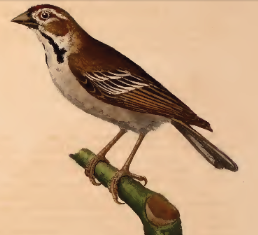
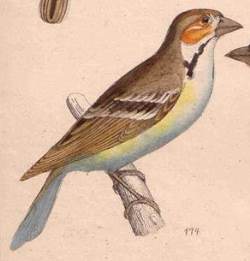 
IntroductionThe Chestnut-crowned Sparrow-weaver was formally described by Philipp Jakob Cretzschmar, a German physician who founded the Senckenberg Natural History Museum in Frankfurt.The collector was Wilhelm Peter Eduard Simon Ruppell, a German naturalist and explorer. Ruppell made two extended expeditions to northern and eastern Africa, the first from 1822-1827 (when he collected the Chestnut-crowned Sparrow-weaver), and the second between 1830 and 1833. Ruppell probably collected the specimens near El Obeid, capital of Kordofan (Steinbacher 1949), Sudan. Ruppell and his colleague Cretzschmar, described many new species based on Ruppell’s collections. The first illustration of a Chestnut-crowned Sparrow-weaver is a colour painting by Cretzschmar 1827. The next published illustration is by Reichenbach 1863, again in colour. Scientific citationPloceus superciliosus Cretzschmar 1827 In Ruppell’s Atlas, Vogel, p.24, pl. 15 Kordofan, Sudan. Meaning of namessuperciliosus Latin: superciliosus, eyebrowed. First English nameChestnut-crowned Sand-Finch (Swainson 1837). Alternate namesChestnut-crowned Sand-Finch, The eyebrowed Philagrus, Cameroon Sparrow-Weaver. CollectorRuppell. Date collected1825 (Steinbacher 1949). Locality collectedProbably El Obeid region, capital of Kordofan (Steinbacher 1949), Sudan. Type specimensTwo types are in Senckenberg but others are possible (Steinheimer 2005). |
The above is based on Weaver Wednesday 2, a weekly series about the discovery of each weaver species.
This species text first appeared as on
1. Basic biology
Adult
| Identification. The Chestnut-crowned Sparrow-Weaver Plocepasser superciliosus adult (painting right) is a brown and white sparrow-like bird, with a distinctive head pattern: rufous crown, white supercilium and subocular mark, rufous patch on cheeks and ear-coverts separated by white line from prominent black malar stripe. It has white wing-bars and wing feather edgings. Sexes are alike. The immature bird is duller and paler than the adult.
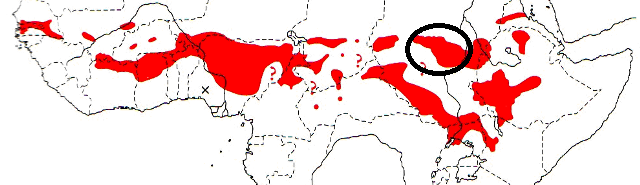
This species was collected by Eduard Rüppell, a German naturalist and explorer, in Kordofan (Sudan) in 1825. He sent his specimens to Philipp Jakob Cretzschmar, a German physician and zoologist, who described around thirty new species in “Atlas zu der Reise im nordlichen Afrika von E. Rüppell”, 1826-30 (“Atlas of Rüppell’s Travels in Northern Africa”), including this species. The description was accompanied by a colour painting (above). Distribution. The Chestnut-crowned Sparrow-Weaver is found in the savanna belt from Senegal across to Eritrea and central Ethiopia and as far south as Kenya. No subspecies are recognised (see map above, based on Birds of Africa). Habitat. The Chestnut-crowned Sparrow-Weaver is found in woodland and tall bush areas. In Nigeria it inhabits mature woodland, but appears to be more common in degraded and overgrazed erosion areas with many thorn bushes. Food. The Chestnut-crowned Sparrow-Weaver feeds on seeds by foraging on the ground, in tall grass heads, and in canopies of large bushes and small trees. It occurs mainly in pairs and can be unobtrusive; sometimes it is found in small flocks and sometimes feeds on the ground in loose flocks with other seed-eaters. There is one record of predation – a python swallowed an adult Sparrow-Weaver in Sudan.
 Breeding. The Chestnut-crowned Sparrow-Weaver is colonial, with several nests in a single tree. It may be a co-operative breeder. The nest (photo above from PHOWN 695) resembles that of the White-browed Sparrow-weaver. Nests are placed on branches rather than slung between them, up to 6 m above the ground. At least ten weaver species,including the Chestnut-crowned Sparrow-weaver, have been recorded as nesting near wasps. The eggs (clutch size is 2) are cream or red, and heavily spotted with grey and lilac. Laying dates are known, but little else is known about its breeding. |
The above is based on Weaver Wednesday, a weekly series about weaver species.
This species text first appeared as Weaver Wednesday [31]: Chestnut-crowned Sparrow-Weaver on 2013-01-16
2. Breeding facts
| Pair bond No information; probably a co-operative breeder Breeding season Nest site Nest building Colony size Clutch size Egg colour Egg size Incubation Chicks and nestling period |
Breeding information based on Handbook of the Birds of the World, Vol. 15.
3. Photos of Weaver Nests
 Vm 27883 |
 Vm 3713 |
 Vm 3712 |
 Vm 695 |
Thumb-nails of recent PHOWN records