
Weaver species list / RELATED SPECIES: Red-billed Buffalo-Weaver / White-billed Buffalo-Weaver / White-headed Buffalo-Weaver
IUCN: Least concern Discovery: 026
Categories: black, cooperative, long tail, acacias, fruit, frogs, baobab, Linnaeus, Gymnogene, pest, Bubalornis+Dinemellia
Discovery
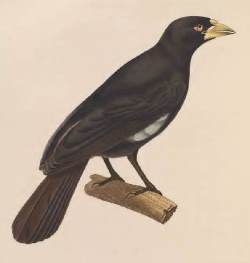 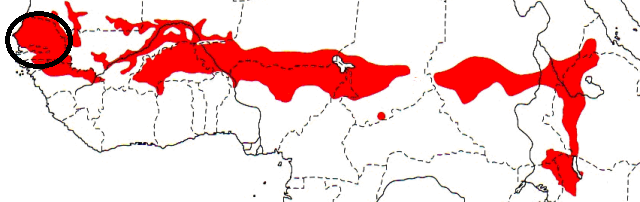
IntroductionThe White-billed Buffalo-Weaver was formally described by Louis Jean Pierre Vieillot, a French ornithologist. Vieillot also gave a French name to this species, ie. Le Gros-bec noir a bec blanc (meaning The black Grosbeak with a white beak).Vieillot described the plumage of the White-billed Buffalo-Weaver and listed it from Africa. The type locality was later restricted to Senegal, based on the amount of white in the wing of this species. This species was already described by Brisson 1760, based on specimens from coastal Africa, in the collection of Madame de Pompadour in 1754. Either Vieillot found these same specimens in the Paris museum and based his description on them, many decades later, or new specimens arrived from Africa. The first illustration of this species to be published, was by Coenraad Jacob Temminck 1828, based on a specimen in the Paris museum, from Galam in Senegal. Again, there is the possibility that this is the same specimen as that of Brisson 1760, although Temminck provided his own name for the species. Scientific citationCoccothraustes albirostris Vieillot 1817 Nouv. Dict. Hist. Nat., nouv. e’d., 13, p.535 Africa. Restricted to Senegal by Hartert, 1907, Novit. Zool., 14, p.485. Meaning of namesalbirostris Latin: albus, white; -rostris, billed. First English nameWhite-billed Nut-cracker (Swainson 1837) – for 2 decades authors used the French or Latin names of this species, before Swainson provided this name. Alternate namesAfrican ox bird, Black Buffalo Weaver, Kavirondo Buffalo-Weaver, Kenya Buffalo-Weaver. CollectorUnknown. Date collectedBefore 1817. Locality collectedAfrica. Restricted to Senegal. Type specimensType specimen probably in the Natural History Museum in Paris. 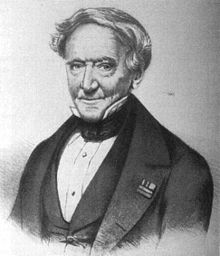 |
The above is based on Weaver Wednesday 2, a weekly series about the discovery of each weaver species.
This species text first appeared as Weaver Wednesday [143] – Discovery [26]: White-billed Buffalo-Weaver on 2015-03-11
1. Basic biology
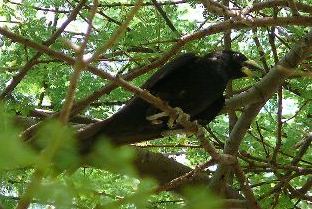 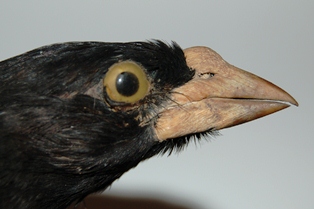
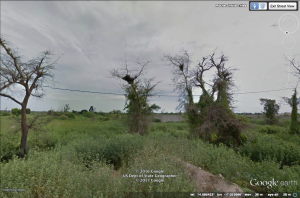
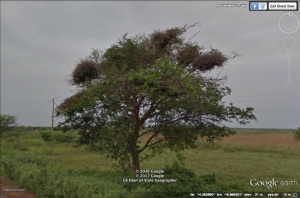
Identification. The White-billed Buffalo-Weaver Bubalornis albirostris is white-billed. The adult (photo above) is black, with white feather bases showing through as small patches on the lower back, flanks and sides of breast; a white wing patch is visible in flight. The conical bill is white and swollen in breeding males (photo above, from specimen 90331 in Leiden), otherwise black. The immature bird is dark brown with white mottling on the underparts. This species also has a phalloid organ (exposed in photo above, see also Red-billed Buffalo-Weaver). Distribution. No subspecies of the White-billed Buffalo-Weaver are recognised. In the past it has been regarded as conspecific with the Red-billed Buffalo-Weaver. It occurs from Senegal across the savanna belt to western Ethiopia and Kenya (see map above, based on Birds of Africa). In 2009 it was recorded from Tanzania for the first time, from Naani Hill Gate, Serengeti National Park.  Habitat. The White-billed Buffalo-Weaver inhabits dry savanna. In West Africa, it is found in very open farmland with patches of scrub, along streams and in belts of thorntrees. White-billed Buffalo-Weaver colonies are often in large trees, in or near villages. It is resident at its nesting colonies; when not breeding, birds forage away the nests but return before sunset to roost in the nest. Food. The White-billed Buffalo-Weaver feeds on seeds, including crops such as millet; also fruit, grasshoppers, termites, beetles and their larvae, and also small animals such as frogs. They forage on the ground, search for insects in cowpats, and remove ectoparasites like ticks from cattle. Large noisy, feeding flocks may include individuals from several colonies. Chicks are fed on insects. Breeding. The White-billed Buffalo-Weaver is strongly colonial (eg. photo). In a 50km transect survey in baobab savanna in Senegal, 31 trees had large colonies and 29 trees had small colonies; while in acacia savanna, 214 nests were counted in 24km. The nest is a large compound structure, >1 m in diameter, containing up to 10 individual nest chambers. It is made of dry thorn twigs and branches, and lined with grass and green leaves. The nest is sometimes solitary. The nest entrance is sometimes surrounded by long thorny twigs sticking out. It is built mainly by the male and both sexes add lining. Males may steal material from neighbours, triggering raucous calling. Nest building activity often follows rainfall. In Tanzania, nests may be abandoned, then re-used in subsequent years. Eggs (clutch 2-4) are whitish or pale greenish, heavily marked with grey and grey-brown. The female incubates the eggs and feeds the young. |
The above is based on Weaver Wednesday, a weekly series about weaver species.
This species text first appeared as Weaver Wednesday [28]: White-billed Buffalo-Weaver on 2012-12-26
2. Breeding facts
| Pair bond Polygynous; colonial Breeding season Nest site Nest building Colony size Clutch size Egg colour Egg size Incubation Chicks and nestling period |
Breeding information based on Handbook of the Birds of the World, Vol. 15.
3. Photos of Weaver Nests
 Vm 28576 |
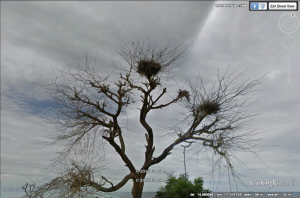 Vm 26288 |
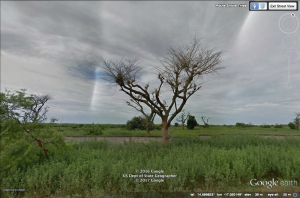 Vm 26287 |
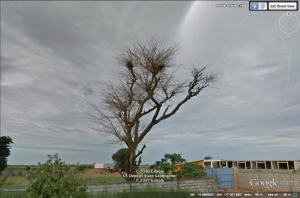 Vm 26286 |
 Vm 26285 |
 Vm 26270 |
Thumb-nails of recent PHOWN records