
Weaver species list / RELATED SPECIES: Red-billed Buffalo-Weaver / White-billed Buffalo-Weaver / White-headed Buffalo-Weaver
IUCN: Least concern Discovery: 047
Categories: cooperative, acacias, fruit, baobab, Nest use, Bubalornis+Dinemellia
Discovery
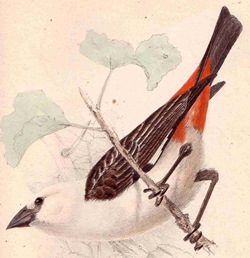 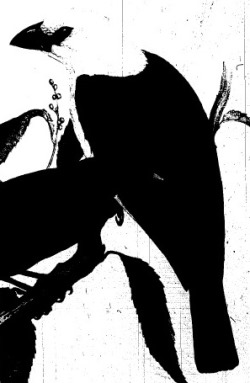 
IntroductionThe White-headed Buffalo-Weaver was formally named by Wilhelm Peter Eduard Simon Rüppell, a German naturalist and explorer, especially in north-east Africa.Rüppell obtained specimens of the White-headed Buffalo-Weaver from 2 sources. Martin Bretzka was a German hunter who collected birds for Rüppell. After earlier travels together, Rüppell sent Bretzka back to Ethiopia in 1835 and Bretzka reached Shoa in 1837, where he presumably collected the first White-headed Buffalo-Weaver specimens. Rüppell probably only received these specimens in 1841, and he labelled them as Textor leucocephalus. Bretzka collected at least 2 specimens, which are now in the Senckenberg Museum in Frankfurt. Before describing this species, Rüppell visited the museum of the East India Company in London in 1843, where he saw some more White-headed Buffalo-Weaver specimens. These had been collected by Major Sir William Cornwallis Harris, an English military engineer, artist and hunter. Harris led a British diplomatic mission (1841 to 1843) from Bombay to Sahle Selassie, Negus of Shewa. Harris collected at least 4 specimens of the White-headed Buffalo-Weaver. Harris wrote about his travels in 3 volumes (The highlands of Aethiopia) in which he makes occasional reference to birds, but does not appear to have written about the White-headed Buffalo-Weaver. Harris sent his White-headed Buffalo-Weaver specimens to the East India Company Museum where Thomas Horsfield, curator of the East India Company Museum in London, named the species Textor dinemelli. Horsfield named the species after an unknown collector, Dinemelli, but did not describe the species. The specimens are now in the British Museum. When Rüppell published his description, he chose Horsfield’s name rather than his own more descriptive name (leucocephalus = white headed). The first illustration of a White-headed Buffalo-Weaver is a colour painting by Joseph Wolf of a specimen collected by Bretzka, published in the book on north-eastern African birds by Rüppell. The second illustration is by William Mitchell, published in the book by Gray on bird genera, and based on the specimens collected by Harris. Scientific citationTextor dinemelli Ruppell 1845 Syst. Uebers, p.72, pl. 30 Shoa, central Abyssinia. Meaning of namesdinemelli – Named after Dinemelli (fl. 1840) a collector in Ethiopia about whom nothing is known. First English nameThe white-headed Dinemellia (Reichenbach 1863). Alternate namesBoehm’s Buffalo Weaver, Dinemelli’s (Buffalo) Weaver, Ruspoli’s White-headed Buffalo-Weaver, Unyamwesi White-headed Buffalo-Weaver. CollectorMartin Bretzka and Major WC Harris. Date collected1837 (Bretzka) and 1841-43 (Harris). Locality collectedShoa = Shewa, central Ethiopia. Type specimensTwo specimens are in the Senckenberg Museum (Bretzka) and 4 in the British Museum (Harris). |
The above is based on Weaver Wednesday 2, a weekly series about the discovery of each weaver species.
This species text first appeared as Weaver Wednesday [164] – Discovery [47]: White-headed Buffalo-Weaver on 2015-08-05
1. Basic biology
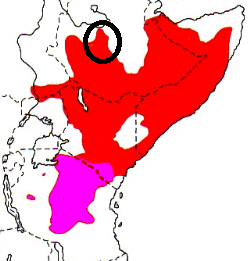
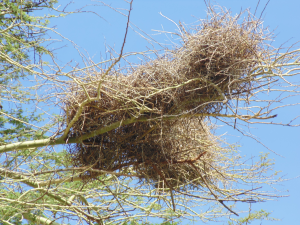
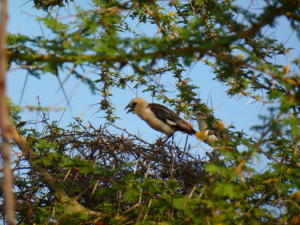
 Identification. The White-headed Buffalo-Weaver Dinemellia dinemelli is in the monotypic genus Dinemellia. The genus is unique among weavers in that the birds are largely white with orange-red rump, undertail coverts and wing shoulder (photo). The sexes are alike and the species colours of white, black and red are unmistakable in the field. Immature birds have pale orange tail coverts, rather than orange-red tail coverts. Distribution. The White-headed Buffalo-Weaver occurs in eastern Africa. The map (above) is based on Birds of Africa, but central Ethiopia has been added to the distribution here as indicated by Ash J and Atkins J (2009. Birds of Ethiopia and Eritrea. An atlas of distribution). Two subspecies are recognised: D. dinemelli dinemelli is found from Sudan to Kenya (yellow on the map) – the upperparts are dark brown. D. dinemelli boehmi is found in SE Kenya and Tanzania (red on the map) – the upperparts are black. Habitat. The White-headed Buffalo-Weaver inhabits dry bush and savanna thornveld, including acacia patches in miombo in Tanzania. It is rare in grassland and riverine vegetation. It occurs in parties of 3-6 birds, and regularly joins mixed-species flocks in open woodland. Food. They forage on the ground and feed mainly on insects but also eat seeds and fruit. Breeding. The White-headed Buffalo-Weaver is monogamous and may be a co-operative breeder.  The nest is built by both sexes. The adults build an inner herbaceous shell of dry grass stems, and then cover the top and sides with a protective layer of thorny twigs. A short entrance tube faces downwards. Nest lining of grass, leaves or feathers is added.There may be a single nest, or several nests which probably belong to a pair. Nests are placed in trees at 2-4 m above the ground. Nests may be placed in trees that have colonies of biting ants, as additional protection from predators. 3-4 eggs are laid, which are greyish white or pale blue, with thick brownish blotches, often forming a cap at the thick end. The incubation period is unrecorded. Chicks are fed by both parents. The nests may be used by Pygmy Falcons and Cut-throat Finches. |
The above is based on Weaver Wednesday, a weekly series about weaver species.
This species text first appeared as Weaver Wednesday [13]: White-headed Buffalo-Weaver on 2012-09-12
2. Breeding facts
| Pair bond perhaps occasional co-operative breeding Breeding season Nest site Nest building Colony size Clutch size Egg colour Egg size Incubation Chicks and nestling period |
Breeding information based on Handbook of the Birds of the World, Vol. 15.
3. Photos of Weaver Nests
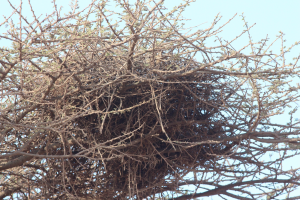 Vm 28553 |
 Vm 13337 |
 Vm 7520 |
 Vm 5660 |
 Vm 5190 |
 Vm 3698 |
Thumb-nails of recent PHOWN records