
Weaver species list / RELATED SPECIES: Aldabra Fody / Comoro Fody / Forest Fody / Madagascar Fody / Mauritius Fody / Rodrigues Fody / Seychelles Fody
IUCN: Least concern Discovery: 007
Categories: island, Foudia, fruit, Linnaeus, nectar, pest, palm, blue eggs
Discovery
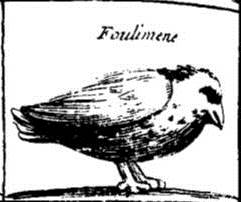 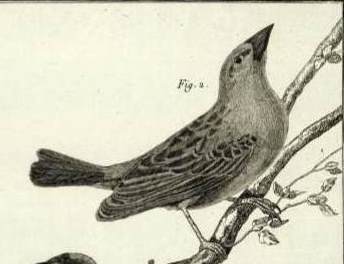 
IntroductionLinnaeus (1766) briefly descriped the Madagascar Fody, based on the longer description in Brisson 1760. Mathurin Jacques Brisson, a French zoologist, gave the names “Le Cardinal de Madagascar” (French) and Cardinalis madagascariensis (Latin). Brisson’s painting is very poor, but his text is extensive, so there is no doubt about the species he was referring to.Brisson noted that the Madagascar Fody originated from Madagascar, from where they were sent to RAF de Reaumur by Pierre Poivre, the administrator of Mauritius and Reunion. Poivre travelled to Madagascar in 1756 (Stresemann 1952) where he collected many bird specimens for de Reaumur. The Madagascar Fody was first illustrated by Etienne de Flacourt, French governor of Madagascar. He wrote a book of the natural history, culture and history of southern Madagascar in 1658, including line drawings of some of the fauna and flora. He called the fody “Foulimene”, and this is probably the first illustration (although a poor one) of any weaver species to appear in print. Flacourt wrote about the fody as being captured by the locals because it was a pest on the rice crops, and he thought them to be beautiful due to their scarlet plumage. Scientific citationLoxia madagascariensis Linnaeus 1766 Syst. Nat., ed. 12, 1, p.300 Madagascar Meaning of namesmadagascariensis After the island of Madagascar. First English nameMadagascar Grosbeak (Latham 1783). Alternate namesMadagascan Fody, Madagascan Red Fody, Red Fody CollectorPierre Poivre. Date collectedIn 1756 when Poivre visited Madagascar. Locality collectedMadagascar. Type specimensPoivre’s type specimens did not survive (Stresemann 1952), but the painting of Brisson serves as a type. |
The above is based on Weaver Wednesday 2, a weekly series about the discovery of each weaver species.
This species text first appeared as Weaver Wednesday [124] – Discovery [7]: Madagascar Fody on 2014-10-29
1. Basic biology
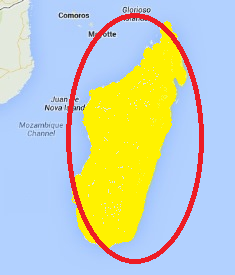
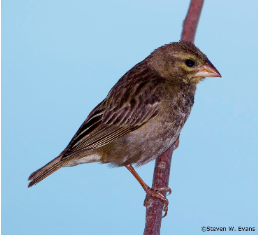 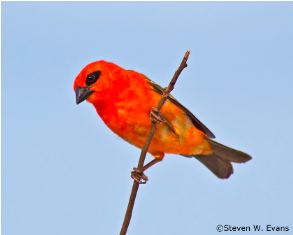 Identification. The Madagascar (or Red) Fody Foudia madagascariensis is abundant in Madagascar, and has been introduced to many other islands. The breeding male is crimson-red, with a short black line through the eye. There is notable variation in the red plumage, with some individuals more orange-coloured, or yellowish, and the brightness of the breast plumage is positively correlated with the male’s body condition. The female and non-breeding male are olive-brown, with faint streaking. The juvenile resembles the female, but may be quite buffy. A fody with entirely red underparts must be a Madagascar Fody, but moulting fodies may be difficult to identify. Distribution. The Madagascar Fody occurs naturally in Madagascar (see red on map above). It has been introduced on Reunion, Mauritius, Seychelles, Rodrigues, Amirantes and Chagos Is, in the Indian Ocean, and also on St Helena in the Atlantic Ocean (see black arrows on map, based on Long JL, 1981, Introduced birds of the world). It has recently been found breeding in Oman and Bahrain. It is also present on Glorieuses and Comoro Islands, which it may have colonized without human assistance. No subspecies are recognised. Successful colonization of islands is thought to be a consequence mainly of its ability to breed successfully in the presence of black rats Rattus rattus. Habitat. The Madagascar Fody inhabits open country, including natural savanna, cultivated areas and towns, and clearings in forest. It is not found in intact forest in Madagascar (except in transit), but forages in forest on Rodrigues Island. Roost-sites include sugar cane, bamboos, tall grasses, reedbeds, and mangroves and other trees. They show well-synchronized entry into and departure from large roosts (read more here).  Food. The Madagascar Fody feeds mainly on seeds; and also on nectar and arthropods. Seeds include those of grasses and rice, both when ripe and when in the milky stage. Arthropods include beetles, caterpillars and moths, and spiders. Nectar is taken from both native and exotic plants; birds often pull out parts of flowers to remove nectar from the base. Nestlings are fed on both seeds and insects. It often occurs in flocks, sometimes of hundreds of individuals, when feeding on seeds and is considered a serious pest in rice-growing areas. As a result, villagers trap and scare birds from fields and destroy nests. 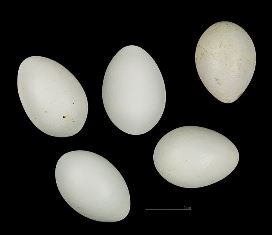 Breeding. The Madagascar Fody is monogamous and probably double-brooded. It is not colonial, but at high density of birds the nests may be close together. The male defends his territory by singing from a prominent perches. The nest is oval, with a side entrance near the top. The entrance is under a projecting porch, and is sometimes extended into a short tunnel. The nest is woven mainly by the male, using grass strips. The nest has been considered one of the most primitive of the nests of the true weavers. Nests are attached to reeds, tall grass, branches of shrubs or trees. Nests not accepted by females may be abandoned or dismantled.The clutch is 2-4 eggs, and the eggs are pale blue-green, slightly glossy. The female incubates, but chicks are fed by both sexes, primarily by regurgitation. Old nests may be taken over by the Madagascar Bibfinch Lepidopygia nana. |
The above is based on Weaver Wednesday, a weekly series about weaver species.
This species text first appeared as Weaver Wednesday [70]: Madagascar Fody (Red Fody) on 2013-10-15
2. Breeding facts
| Pair bond Monogamous Breeding season Nest site Nest building Colony size Clutch size Egg colour Egg size Incubation Chicks and nestling period |
Breeding information based on Handbook of the Birds of the World, Vol. 15.
3. Photos of Weaver Nests
 Vm 16857 |
 Vm 16856 |
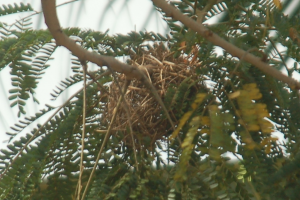 Vm 16855 |
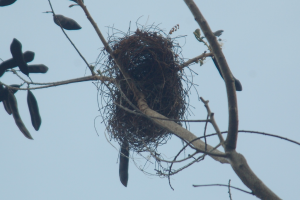 Vm 16854 |
 Vm 16851 |
 Vm 16850 |
Thumb-nails of recent PHOWN records