
Weaver species list / RELATED SPECIES: Aldabra Fody / Comoro Fody / Forest Fody / Madagascar Fody / Mauritius Fody / Rodrigues Fody / Seychelles Fody
IUCN: Near threatened Discovery: 066
Categories: white eggs, island, Foudia, fruit, IUCN, nectar, palm
Discovery
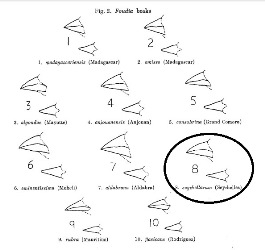 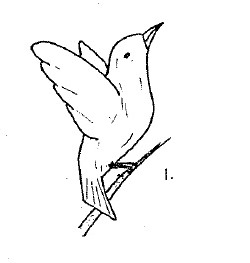  
IntroductionThe Seychelles Fody was formally described by Edward Newton, a British colonial administrator and ornithologist. Newton was the Colonial Secretary for Mauritius from 1859 to 1877. In Jan-Feb 1866 he visited the Seychelles.On 12 February 1866, Newton landed on Marianne Island, looking for a bird known on that island as “Le Mangeur de riz” (French for Rice Eater). This bird turned out to be the Seychelles Fody. Newton shot three specimens which are now in the museum in Cambridge. Newton also observed some fifty to a hundred similar dull coloured birds on the island, and wrote: By 1961 the Seychelles Fody was found to be extinct on Marianne. The first illustration pertaining to Seychelles Fody was of the bill shapes of different fody species by Moreau (1960). The next illustration was a line drawing of displaying male by Crook (1961). Possibly because the Seychelles Fody is the least colourful of all the fodies, there was a long interval between description and first illustrations. The first time all the fodies were illustrated was by Watson (1963), although these were line drawings (not colour) for identification purposes. Colour photos and paintings of the Seychelles Fody start appearing in the 1970s. Scientific citationFoudia sechellarum Newton 1867, Proc. Zool. Soc. London, p.346, Marianne Island. Meaning of namessechellarum After the Seychelles Islands (Republic of Seychelles). First English nameSeychelles Fody (Shelley 1905). Alternate namesToc-toc. CollectorEdward Newton. Date collected12 Feb 1866 Locality collectedMarianne Island, Seychelles. Type specimensThere are 3 syntype specimens in at Cambridge (Cambridge 27/Plo/6/f/1-3) where Alfred Newton was based. |
The above is based on Weaver Wednesday 2, a weekly series about the discovery of each weaver species.
This species text first appeared as Weaver Wednesday [183] – Discovery [66]: Seychelles Fody on 2015-12-16
1. Basic biology
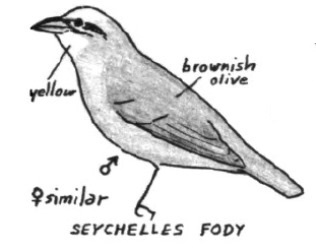
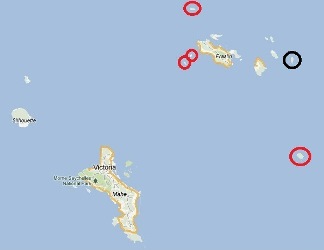
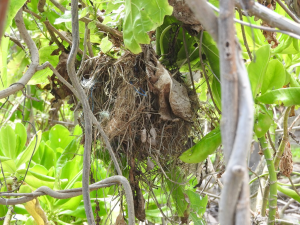
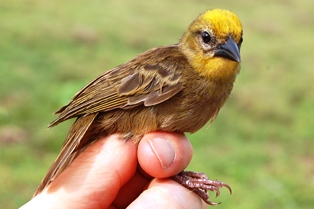 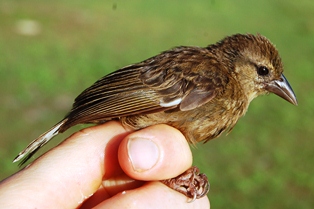 Identification. The Seychelles Fody, locally known as toc-toc due to its calls, is the least coloured fody species. Adult male toc-tocs (photo) are mostly olive-grey with the back and wings slightly darker and streaked. The forehead, crown and throat are dull yellow, to a varying extent. The male has a faded black eye-stripe rather than a well-defined one typical of other fodies. Adult female (photo) and juvenile toc-tocs are mostly olive-grey in colour with a slightly darker back and wings. An unusual feature in this species is the variable number of white primary coverts in many males and some females (see photos here). Distribution. The Seychelles Fody is present on six islands: Cousin, Cousine, Fregate, Aride (reintroduced in 2002), d’Arros (introduced in 1965) and Denis (introduced 2004). The map above shows some of these islands circled in red; d’Arros is far to the left off the map, and Denis far to the north. Before European settlement it was probably widely distributed in the Seychelles, but only confirmed from Marianne, Cousin, Cousine and Fregate. By the 1940s it was extinct on Marianne. The increase in the Cousin lsland population, and successful reintroduction to Aride and Denis lslands resulted in the fody being downlisted from Vulnerable to Near threatened. Habitat. The Seychelles Fody inhabits highly modified habitats such as human settlements, coconut and Casuarina plantations, and other exotic vegetation types. Originally it was probably restricted to native humid forest, in which it still occurs on Cousin and Aride, including hill and marsh areas. Food. The toc-toc is mainly insectivorous but also feeds on seed, fruit and nectar. It may be unique among weavers in its habit of rarely feeding on the eggs of seabirds.  Breeding. The Seychelles Fody is a socially monogamous weaver. The peak breeding season, between May and October, coincides with the southeast monsoon or dry season but toc-tocs may breeding all year round. One, but more often two eggs are laid in a globular, enclosed, woven nest (photo) and incubation is done entirely by the female. Both sexes participate in nest building, nestling and fledgling care. After fledging, parents attend their young for an average of 12 weeks, much longer than in other weavers. An interesting study found post-fledging brood division between the sexes on Cousin, i.e. the parent male feeds male fledglings and the parent female feeding male fledglings; single fledglings are cared for only by the female parent; in the few observed broods with 2 female offspring, the male parent cares for one of them. Nest predators that have been recorded are: gecko, Wright’s Skink, Seychelles wolf snake, and Common myna. See a video clip of the antics of a pair of Seychelles Fodies collecting nest material here. The oldest known Seychelles Fody is at least 14 years old (see here). |
The above is based on Weaver Wednesday, a weekly series about weaver species.
This species text first appeared as Weaver Wednesday [4]: Seychelles Fody on 2012-07-11
2. Breeding facts
| Pair bond Monogmous; pair-members remain together for several consecutive seasons Breeding season Nest site Nest building Colony size Clutch size Egg colour Egg size Incubation Chicks and nestling period |
Breeding information based on Handbook of the Birds of the World, Vol. 15.
3. Photos of Weaver Nests
 Vm 26676 |
 Vm 8889 |
Vm 1939 |
 Vm 1258 |
Thumb-nails of recent PHOWN records