
Weaver species list / RELATED SPECIES: Chestnut-crowned Sparrow-Weaver / Chestnut-mantled Sparrow-Weaver / Donaldson-Smith’s Sparrow-Weaver / Rufous-tailed Weaver / White-browed Sparrow-Weaver
IUCN: Least concern Discovery: 038
Categories: Plocepasser, long tube, cooperative, acacias, gum
Discovery
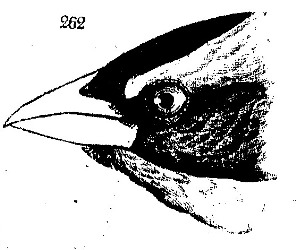 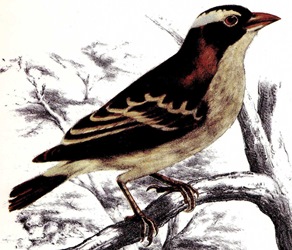 
IntroductionThe White-browed Sparrow-weaver was collected and formally described by Andrew Smith, a Scottish surgeon, explorer, ethnologist and zoologist. Smith organised an expedition to the interior and he travelled to near the Botswana border in 1834-35, collecting many new birds, reptiles, mammals and other taxa along the way.Smith described the White-browed Sparrow-weaver from between the Orange River and the Tropic (Smith 1836) and later he described the locality as ‘upon a tree on one of the tributary streams of the great northern branch of the Orange River’ (Smith 1841). Smith crossed the Vaal, Modder, Black Modder and the Riet rivers (Smith 1836: 15) on his journey between Thaba Nchu and Philippolis on 4-17 December 1834. From his diary, it is clear that Smith moved east from Thaba Nchu until he reached the Modder River (Oschadleus 2007). He stayed here a few days collecting specimens, including the White-browed Sparrow-weaver, then moved south-east to Philippolis (Kirby 1939). Macdonald (1957) correctly restricted the type-locality to the Modder River near Bloemfontein. Clancey (1957, 1959) incorrectly changed this to the confluence of the Modder and Riet rivers, because he thought that Smith did not cross the Modder River near Bloemfontein. Clancey based his supposition on the map in Kirby (1940) where the upper reaches of the Modder River are not shown, but he did not read the diary. The first illustration of a White-browed Sparrow-weaver was published by Swainson 1837, based on a specimen Smith sent to England. The first colour illustration was published by Andrew Smith in 1841 in his well known work, Illustrations of the Zoology of South Africa, and the White-browed Sparrow-weaver was painted by George Henry Ford. Scientific citationPlocepasser Mahali Smith 1836; Rep. Exped. Centr. Africa, p.51; ‘country between the Orange River and the Tropic’ = Modder River, Thabanchu, South Africa. Meaning of namesmahali – no explanation given by Smith, not a Latin name, probably based on an African name. First English nameThe Mahali Philagrus (Reichenbach 1863). Alternate namesBlack-billed Mahali Weaverbird, Black-billed Sparrow Weaver, Kismayu Sparrow-Weaver, Stripe-breasted Sparrow Weaver, White-browed Weaver Bird, White-crowned Weaver-Bird. CollectorAndrew Smith. Date collected6 Dec 1834. Locality collectedModder River, near Thaba Nchu, Free State, South Africa. Type specimensThere are at least 3 syntype specimens in different museums: BMNH 1845.7.6.132, ANSP 14256 and ANSP 14257. |
The above is based on Weaver Wednesday 2, a weekly series about the discovery of each weaver species.
This species text first appeared as Weaver Wednesday [155] – Discovery [38]: White-browed Sparrow-weaver on 2015-06-02
1. Basic biology
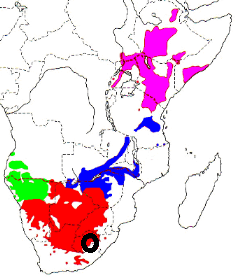
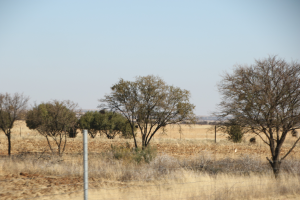
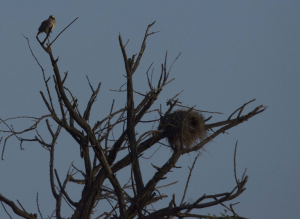
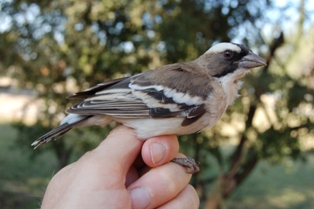 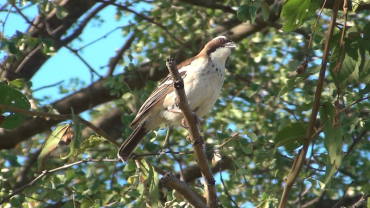 Identification. The White-browed Sparrow-Weaver is a large brown and white weaver that is fairly common. It has a conspicuous broad white stripe from above the eye backwards, and 2 prominent white wing-bars and wing edgings. In flight, a large white patch on the rump and uppertail-coverts is visible. 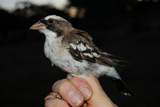 Distribution. The White-browed Sparrow-Weaver the most widespread of the sparrow-weavers, occurring in southern and eastern Africa. It has four subspecies: The White-browed Sparrow-Weaver appears to have increased its range and abundance in many areas (read more here and Kruger). For example, in the Eastern Cape it was first seen on Rookwood farm in the 1980s, and since 2000 has several colonies (see sparrow-weaver colonies on Rookwood here). This species has probably increased in number of nests at Barberspan (see here). The species seems to be increasing in Kenya, e.g. it was described as a new-comer to Ngulia in the past 2 years (VM 1977) and is increasing in Nairobi. Habitat. The White-browed Sparrow-Weaver inhabits mopane and acacia savanna, with <600 mm annual rainfall. It is also found in riverine fringes and gardens. Food. The White-browed Sparrow-Weaver feeds on insects and seeds. Insects include termites, weevils, tenebrionid beetles, ants, caterpillars and small moths. Seeds of grasses and cereals are important in winter. It takes bread and other scraps at camp sites.  Breeding. The White-browed Sparrow-Weaver is a colonial, cooperative breeder, living in groups of 2-11 birds. There is a single breeding female in each group, that is replaced by another group member in time. There is a dominant, breeding male that is eventually replaced from outside the group. Helpers related to the breeding pair help defend the territory and feed the young; unrelated helpers only help in group defence of the territory. The average colony size is 16 nests, but may be up to 20 nests in a single tree. The nest is an elongated retort ball, with a domed roof. It is built only from dry grasses 15-60cm long. One occupied nest contained 983 pieces of grass. About 60% of roosting nests are converted to breeding nests by closing one of the 2 entrances, and then lining with feathers. The nest is placed in trees, 2-8 m above the ground. Mopane and Acacia trees are often favoured. Most nests are placed on the side of the tree away from the prevailing wind. Nest construction takes 10-18 days; and is by both members of the pair and helpers may contribute. Nest-building activity is throughout the year. Its nest sometimes has a longer entrance, as shown right. Birds like the Ashy Tit Parus griseus, Black-checked Waxbill Estrilda erythronotos and Red-headed Finch Amadina erythrocephala may use their nests for roosting. |
The above is based on Weaver Wednesday, a weekly series about weaver species.
This species text first appeared as Weaver Wednesday [2]: White-browed Sparrow-Weaver on 2012-06-27
2. Breeding facts
| Pair bond Monogamous, co-operative breeding system with helpers Breeding season Nest site Nest building Colony size Clutch size Egg colour Egg size Incubation Chicks and nestling period |
Breeding information based on Handbook of the Birds of the World, Vol. 15.
3. Photos of Weaver Nests
 Vm 29305 |
 Vm 29293 |
 Vm 29283 |
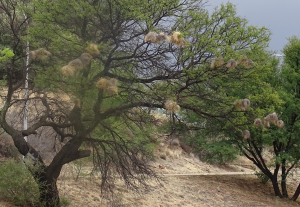 Vm 29219 |
 Vm 29218 |
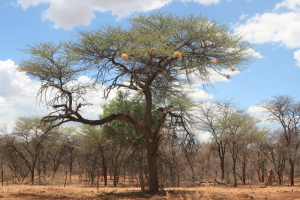 Vm 29190 |
Thumb-nails of recent PHOWN records