
Weaver species list / RELATED SPECIES: Baglafecht Weaver / Bannerman’s Weaver / Bertram’s Weaver / Giant Weaver / Orange Weaver / Principe Golden Weaver / Vieillot’s Black Weaver / Weyns’s Weaver
IUCN: Least concern Discovery: 024
Categories: golden, wetland, fruit, waterbirds, palm
Discovery
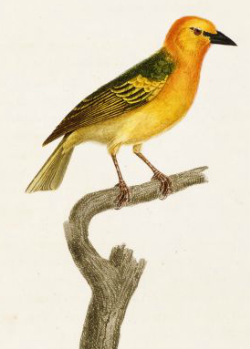 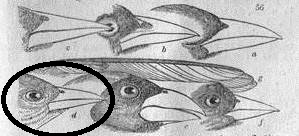 
IntroductionThe Orange Weaver was formally described by Louis Jean Pierre Vieillot, a French ornithologist. The birds had been collected by Jean Perrein, a French naturalist, who travelled in Africa and on other continents. Vieillot was interested in the habits of living birds, but Perrein did not seem to provide any field notes for the Orange Weaver, as he had done for the Crested Malimbe.Vieillot mentioned that the Orange Weaver had been collected in the same area as the previous species in his publication, ie. the Crested Malimbe. Thus the type locality is Malimbe, now called Malembo, in Cabinda, Angola. Perrein sent his specimens to Academy of Sciences in Bordeaux, France, from where the Orange Weaver type was moved to the Paris Museum (Swainson 1838). Scientific citationMalimbus aurantius Vieillot 1805 Ois. Chant. p.73 Malimbe. Meaning of namesaurantia Mod. Latin aurantius, orange-coloured, tawny (aurantia, an orange). First English nameOrange Weaver (Shelley 1905) Alternate namesUganda Orange Weaver. CollectorJean Perrein. Date collectedBefore 1805. Locality collectedMalimbe =Malembo, Cabinda, Angola. Type specimensType specimen probably still in the Natural History Museum in Paris. |
The above is based on Weaver Wednesday 2, a weekly series about the discovery of each weaver species.
This species text first appeared as Weaver Wednesday [141] – Discovery [24]: Orange Weaver on 2015-02-25
1. Basic biology
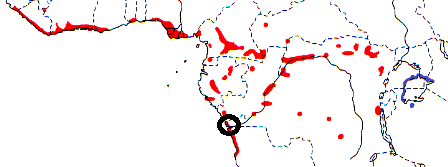
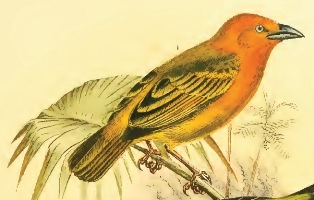 Identification. The Orange Weaver Ploceus aurantius has a pale slender bill and reddish-brown or pale grey eye. The male is orange-yellow, sometimes with a black spot in front of the eye. The female and young birds are dull coloured. There is no seasonal change in plumage. According to Nik Borrow, the eye colour of western Orange Weavers (aurantius) is red and those of Ugandan Orange Weavers (rex) is pale bluish (photos on facebook). Distribution. The Orange Weaver is localized, often uncommon, and occurs from Sierra Leone in West Africa across to Lake Victoria, and south to northern Angola (see map above, based on Birds of Africa). Two subspecies of the Orange Weaver are recognised: A third subspecies, P. a. royrei is not valid but the type may be viewed here. In Liberia, Orange Weavers are found along the coast and on rocky islets up to 1.5 km offshore, where they nest low down in shrubs on the leeward side but commute to the mainland for foraging. Habitat. The Orange Weaver inhabits mangroves, thickets in coastal lagoons, small creeks and estuaries in West Africa; inland it occurs along major rivers; and around Lake Victoria it is found in papyrus swamps.  Food. It feeds on fruit, including berries, fruit pulp and seeds; also insects, including adults and eggs of locusts, beetles, and caterpillars. It is usually found in pairs or small groups. Breeding. The Orange Weaver is probably polygynous. It is colonial, and there may be between 12 and several hundred nests at some sites, but sometimes single nests. Nest sites include reeds, palms and other trees. It may form mixed colonies with other weavers. The nest is built by the male. The nest is ovoid, with no entrance tunnel in central and West Africa, and with a short tunnel in Uganda. The nest is tightly woven from grass or palm strips. The eggs (clutch of 2) are pale blue, green, brown or reddish, with fine lilac and brown spots, usually denser at the thick end. Incubation is by the female. |
The above is based on Weaver Wednesday, a weekly series about weaver species.
This species text first appeared as Weaver Wednesday [51]: Orange Weaver on 2013-06-05
2. Breeding facts
| Pair bond Presumably polygynous Breeding season Nest site Nest building Colony size Clutch size Egg colour Egg size Incubation Chicks and nestling period |
Breeding information based on Handbook of the Birds of the World, Vol. 15.
3. Photos of Weaver Nests
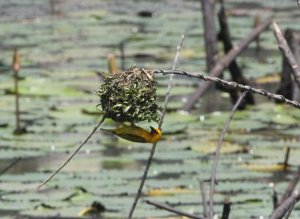 Vm 27826 |
 Vm 26342 |
 Vm 13829 |
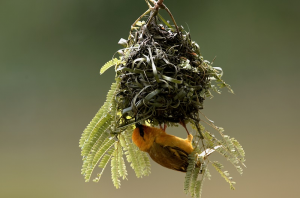 Vm 13803 |
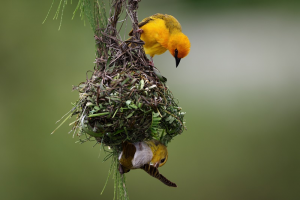 Vm 13802 |
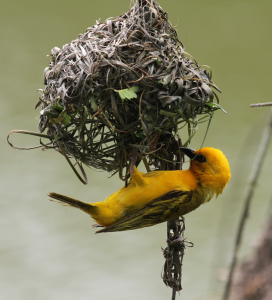 Vm 9888 |
Thumb-nails of recent PHOWN records