
Weaver species list / RELATED SPECIES: Chestnut-crowned Sparrow-Weaver / Chestnut-mantled Sparrow-Weaver / Donaldson-Smith’s Sparrow-Weaver / Rufous-tailed Weaver / White-browed Sparrow-Weaver
IUCN: Least concern Discovery: 097
Categories: Plocepasser, cooperative
Discovery
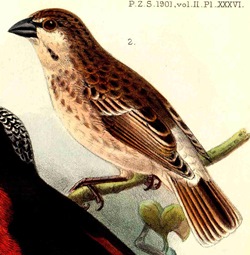
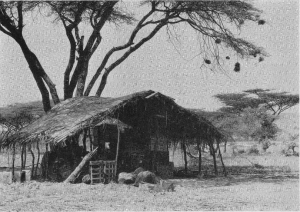
 IntroductionDonaldson-Smith’s Sparrow-Weaver was formally described by Richard Bowdler Sharpe, an English zoologist.Donaldson-Smith’s Sparrow-Weaver was collected by Arthur Donaldson Smith, an American doctor, amateur big-game hunter, and explorer of Africa. In in 1894-95 Donaldson Smith undertook an 18-month geological expedition in East Africa. The expedition started in Berbera, Somalia (then British Somaliland), passed through what was then Somaliland, southern Ethiopia and then to Lake Rudolph (now Lake Turkana) in Kenya. Donaldson Smith collected birds and many animals, particularly fish, spiders, scorpions, butterflies and beetles. The expedition left Lake Rudolf on 24 August 1895, and went SW, and crossed Marsabit Mt. On 13 September Donaldson Smith had a close encounter with an elephant, and the next day he collected the weaver specimen. He reached Lasamis on 16 September. 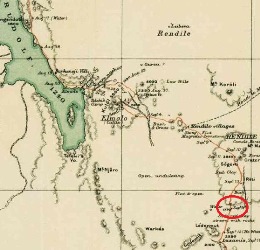 Donaldson Smith wrote a book about his travels, which can be downloaded here (295 Mb). The first illustration of the Donaldson-Smith’s Sparrow-Weaver was of an adult, published by Sharpe (1901). The next illustration was a black and white photo of nests by Oberholser (1945). Scientific citationPlocepasser donaldsoni Sharpe 1895a, Bull. Br. Orn. Club, 5, p.14 ‘Eastern Africa’ = Lasamis, Kenya. Meaning of namesdonaldsoni, Named after A. Donaldson-Smith (1864-1939) US zoologist and collector in Somaliland, 1894-1895. First English nameDonaldson Sparrow-Weaver (Shelley 1905b). Alternate namesDonaldson’s Sparrow-Weaver, Somali Grey Sparrow Weaver. CollectorArthur Donaldson Smith. Date collected14 Sep 1895. Locality collectedLasamis, Kenya. Type specimensThe type is in the British Museum (BM 1895.7.7.23).
|
The above is based on Weaver Wednesday 2, a weekly series about the discovery of each weaver species.
This species text first appeared as Weaver Wednesday [214] – Discovery [97]: Donaldson-Smith’s Sparrow-Weaver on 2016-07-20
1. Basic biology
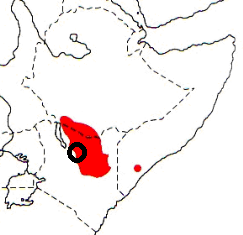
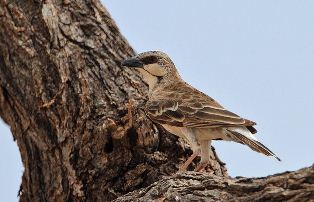 figure from wikipedia Identification. Donaldson-Smith’s Sparrow-Weaver is a localised species in East Africa. It overlaps in range with the more widespread White-browed Sparrow-weaver. Both species have a white rump, but the Donaldson-Smith’s Sparrow-Weaver has no obvious white in the wing and has a very different head pattern (scaly crown, no white eyebrow, pale cheeks with black moustachial stripe). Distribution. Donaldson-Smith’s Sparrow-Weaver is found in southern Ethiopia (eg. Mago National Park, but rare in Omo National Park) and in northern Kenya (particularly in the Isiolo district game reserves). In Somalia, it has only been recorded at Afmadow (see map above, based on Birds of Africa). It is a common but very local bird. No subspecies of the Donaldson-Smith’s Sparrow-Weaver have been proposed. Donaldson-Smith’s Sparrow-Weaver is poorly-known. Its call has been recorded – see here. Habitat. Donaldson-Smith’s Sparrow-Weaver inhabits dry bushland, open woodland, grassland and rocky areas; and even in barren lava country in north Kenya. Food. Donaldson-Smith’s Sparrow-Weaver forages on the ground, feeding on grass seeds and insects. It occurs in small flocks, which may associate with the White-headed Buffalo-Weaver. Breeding. Donaldson-Smith’s Sparrow-Weaver is colonial. Its mating system is unknown but it is probably a co-operative breeder, like other sparrow-weavers. The nest is a mass of grass with a short entrance tube, lined with feathers; it resembles the nests of other sparrow-weavers, but is larger than that of the White-browed Sparrow-Weaver. The nest is placed in low thorn trees 1.5-3m above the ground, or in stunted bushes. A colony of 20 nests in a single bush has been recorded. The eggs are pinkish or greyish, with fine speckles of mauve and reddish-brown, but clutch size has not been recorded.  figure from PHOWN 3221  figure from PHOWN 3221 |
The above is based on Weaver Wednesday, a weekly series about weaver species.
This species text first appeared as Weaver Wednesday [37]: Donaldson-Smith’s Sparrow-Weaver on 2013-02-27
2. Breeding facts
| Pair bond No information; probably a co-operative breeder Breeding season Nest site Nest building Colony size Clutch size Egg colour Egg size Incubation Chicks and nestling period |
Breeding information based on Handbook of the Birds of the World, Vol. 15.

3. Photos of Weaver Nests
 Vm 24562 |
 Vm 9254 |
Vm 3221 |
 Vm 2646 |
Thumb-nails of recent PHOWN records