
Weaver species list / RELATED SPECIES: Baglafecht Weaver / Bannerman’s Weaver / Bertram’s Weaver / Giant Weaver / Orange Weaver / Principe Golden Weaver / Vieillot’s Black Weaver / Weyns’s Weaver
IUCN: Least concern Discovery: 093
Categories: acacias, nectar, palm
Discovery
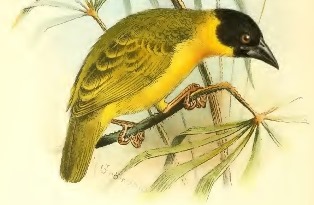
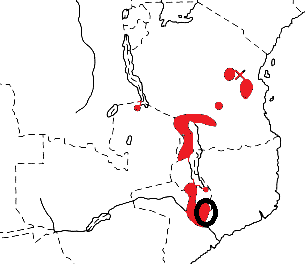 IntroductionBertram’s Weaver was formally described by George Ernest Shelley, an English geologist and ornithologist.Bertram’s Weaver was collected by Alexander Whyte, a Scottish botanist. Commissioner HH Johnston hired Alexander Whyte to collect fauna and flora specimens in British Central Africa. Bertram Lutley Sclater, the son of the ornithologist Dr. P. L. Sclater, and Commander of the Police Force of British Central Africa 1891-93, accompanied the expedition as security. Whyte collected birds in 3 localities in southern Malawi in 1891. On 29 May they ascended Mt Zomba, then collected specimens here during Aug-Sep, including two Bertram’s Weaver specimens. On 20 Oct the expedition visited Mt Milanji spending 2 weeks on the plateau, collecting one Bertram’s Weaver specimen. Whyte also collected several female Bertram’s Weaver specimens in southern Malawi during 1892. These were also investigated by Shelley (in 1894) who described them as males of a separate species. A few decades later, Neunzig 1924a realised that these were the female of Bertram’s Weaver, based on a large sample of specimens of both taxa in the Berlin Museum. Shelley named Bertram’s Weaver after Bertram Lutley Sclater, but the scientific name was given as bertrandi rather than as bertrami. The first illustration of Bertram’s Weaver was of a male and juvenile, published by Shelley (1893) in his initial description of the species. The next illustration was of the female of this species in Shelley (1905), initially thought to be the male of a different species.
Scientific citationHyphantornis bertrandi Shelley 1893a, Ibis, p.23, pl. 2, Plains near Milanji, southern Nyasaland [Zomba]. Meaning of namesbertrandi, Named after Captain Bertrand L. Sclater (1866-1897). First English nameNyasa Black-beaded Weaver (Shelley 1905b). Alternate namesBertrand’s Weaver, Bertrand’s Masked-Weaver, Nyasa Black-beaded Weaver. CollectorAlexander Whyte. Date collectedAug, Sep, Oct 1891. Locality collectedMilanji (Mount Mulanje) and Zomba, Malawi. Type specimensThree syntypes are in the British Museum (eg BM 1892.9.10.181). |
The above is based on Weaver Wednesday 2, a weekly series about the discovery of each weaver species.
This species text first appeared as Weaver Wednesday [210] – Discovery [93]: Bertram’s Weaver on 2016-06-22
1. Basic biology
Male
Female
 |
The above is based on Weaver Wednesday, a weekly series about weaver species.
This species text first appeared as Weaver Wednesday [80]: Bertram’s Weaver on 2013-12-25
2. Breeding facts
| Pair bond Monogamous Breeding season Nest site Nest building Colony size Clutch size Egg colour Egg size Incubation Chicks and nestling period |
Breeding information based on Handbook of the Birds of the World, Vol. 15.
3. Photos of Weaver Nests
No records yet – be the first to submit a PHOWN record!