
Weaver species list / RELATED SPECIES: Bates’s Weaver / Blue-billed Malimbe / Cassin’s Malimbe / Crested Malimbe / Gola Malimbe / Ibadan Malimbe / Rachel’s Malimbe / Red-crowned Malimbe / Red-vented Malimbe / Sao Tome Weaver
IUCN: Least concern Discovery: 052
Categories: long tube, white eggs, cooperative, Malimbus, nectar, palm
Discovery
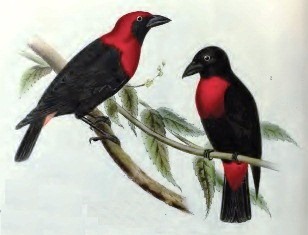 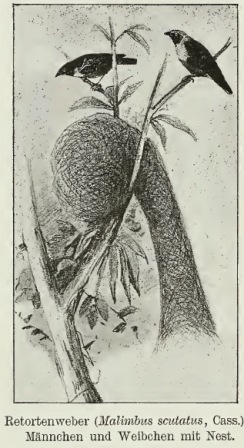 
IntroductionThe Red-vented Malimbe was formally described by John Cassin, an American ornithologist and curator of the Academy of Natural Sciences of Philadelphia (ANSP), now Academy of Natural Sciences of Drexel University. Cassin incorrectly typed Scobius scutatus for the type description, even though he listed the genus header Sycobius correctly and in all future publications he also listed Sycobius scutatus correctly.The Red-vented Malimbe was collected by Dr Robert MacDowell, a surgeon attached to the colonial government of Sierra Leone. The type locality is given as Western Africa but has been inferred to be Sierra Leonne, where MacDowell was based. MacDowell collected several types of bird species, with type localities listed as either West Africa, or as “St. Paul’s River, western Africa”, eg the White-crested Hornbill was collected at St. Paul’s River. Bates (1937) suggested that the Red-vented Malimbe was also collected at St. Paul’s River, which is in Liberia. This suggestion by Bates has been overlooked by other authors. MacDowell’s specimens were obtained by ANSP. Cassin published more on the birds of Africa than on birds from other continents, because of the large collections received from West Africa and other parts of Africa, especially from Du Chaillu and MacDowell (or McDowell) (Stone 1899). The first illustration of a Red-vented Malimbe is a colour painting published by Cassin 1850. The second illustration was published by George Shelley when he described what he thought was a new malimbe (Malimbus rubropersonatus, but later he realised that it was an immature Red-vented Malimbe – the illustration appears under the Biology section. The third illustration for the species was the first time that the well woven nest was illustrated (Buttikofer 1890). Scientific citationS[y]cobius scutatus Cassin 1849 Prov. Acad. Nat. Sci. Philadelphia, 4, p.157, Western Africa (inferred to be Sierra Leonne). Meaning of namesscutatus – Latin: scutatus, armed with a shield (scutum, a shield) – this refers to the red breast of the bird. First English nameThe shield Malimbus (Reichenbach 1863) – see Latin name above. Alternate namesCameroon Red-rumped Malimbe, Red-rumped Malimbe, Red-vented Weaver, The shield Malimbus. CollectorDr Robert MacDowell. Date collectedBefore 1849, but date unknown. Locality collectedWestern Africa, probably near St. Paul’s River in Liberia. Type specimensMacDowell collected 2 pairs: ANSP 14104 (holotype), ANSP 14106, ANSP 14105, ANSP 14107 and these are housed in the Academy of Natural Sciences of Drexel University. |
The above is based on Weaver Wednesday 2, a weekly series about the discovery of each weaver species.
This species text first appeared as Weaver Wednesday [169] – Discovery [52]: Red-vented Malimbe on 2015-09-09
1. Basic biology
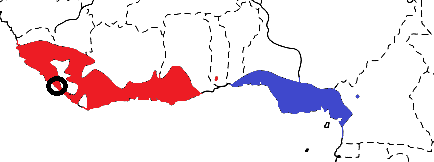
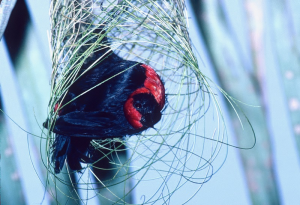
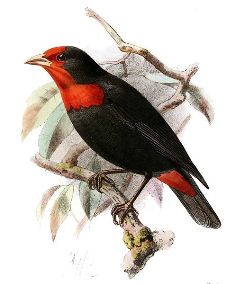 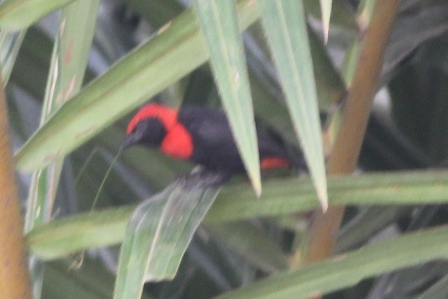 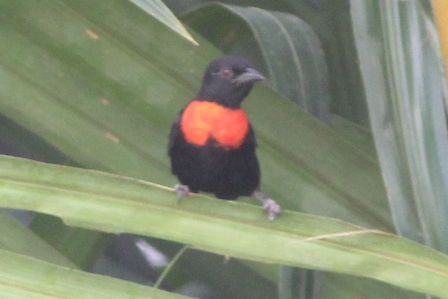 Identification. The Red-vented Malimbe has a red breast and vent – the red vent with black belly separates it from all other malimbes of any age or sex. The male Red-vented Malimbe also has the crown and nape red. The immature has a pale bill. The species was first described by John Cassin, who also published the first illustration of the adults (photo). George Shelley described what he thought was a new malimbe as Malimbus rubropersonatus, but later he realised that it was an immature Red-vented Malimbe (photo). Distribution. The Red-vented Malimbe is a common weaver in West African lowland forests. Two subspecies are recognised (see map above, based on Birds of Africa): M. s. scutatus from Sierra Leone to Ghana, with 2 sightings from Togo in 1990 (see red on map). Habitat. The Red-vented Malimbe inhabits mature and secondary forest, small and large forest clearings, forest edges, gallery forest, swamp forest, and well-wooded savanna. It is closely associated with palm trees, living near and nesting in them in both forest and open, cultivated land and around villages. It keeps mainly to the upper strata in forest, foraging higher than any other malimbe. The Red-vented Malimbe is found in pairs or groups of up to 5 adults. It sometimes joins mixed-species foraging flocks of insectivorous birds. Non-breeding birds roost at night in their old nests. Food. The Red-vented Malimbe feeds on insects, including caterpillars, obtained by gleaning and sometimes by aerial sallies; it also feeds on the husks of oil palm nuts. Breeding. Red-vented Malimbe nests are often alone but sometimes 3-7 are found together, but only one is occupied. The nest is a neatly woven ‘inverted sock’ with a globular egg chamber and long entrance tube. The entrance tube is semi-transparent and beautifully woven – it looks delicate but is remarkably robust. The tube length may be up to 64 cm long, but is usually shorter. An adult arriving in flight dives upward into the entrance with closed wings, and grasps it inside with its feet and then clambers up to the chamber. The nest is built by both sexes, and is typically suspended from the centres of 2 adjacent palm leaflets, or the tips of the leaflets. Nests are often placed in palm trees. One nest took 21 days to complete. The eggs are pure white – only a few weavers consistently lay white eggs. Nothing else is known about incubation and care of the young. 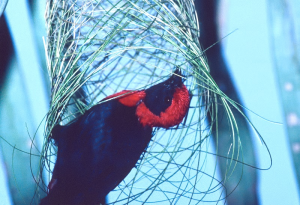  |
The above is based on Weaver Wednesday, a weekly series about weaver species.
This species text first appeared as Weaver Wednesday [46]: Red-vented Malimbe on 2013-05-01
2. Breeding facts
| Pair bond Monogamous Breeding season Nest site Nest building Colony size Clutch size Egg colour Egg size Incubation Chicks and nestling period |
Breeding information based on Handbook of the Birds of the World, Vol. 15.
3. Photos of Weaver Nests
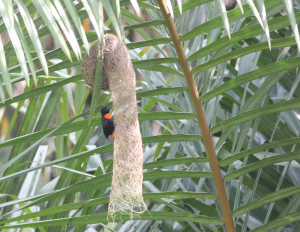 Vm 27824 |
 Vm 13828 |
Vm 7442 |
 Vm 5331 |
Thumb-nails of recent PHOWN records