
Weaver species list / RELATED SPECIES: Bates’s Weaver / Blue-billed Malimbe / Cassin’s Malimbe / Crested Malimbe / Gola Malimbe / Ibadan Malimbe / Rachel’s Malimbe / Red-crowned Malimbe / Red-vented Malimbe / Sao Tome Weaver
IUCN: Endangered Discovery: 115
Categories: long tube, cooperative, Malimbus, IUCN, palm
Discovery
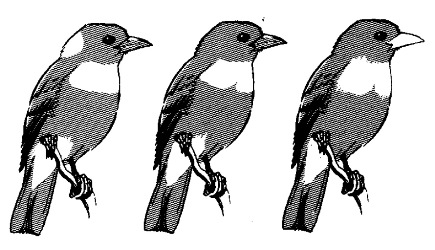
Gola Malimbe holotype, figure from Bonn Museum 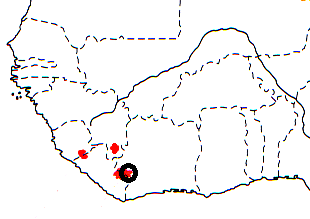 IntroductionThe Gola Malimbe was formally described by Hans Edmund Wolters, a German ornithologist. The Gola Malimbe was first collected by Dr Peter Ballmann, a German geoscientist.Ballmann collected a specimen in 1972 in Eremospatha und Diospyros manii forest, and kept the bird in alcohol, not realising at first that he had found a new species. The previous year, in 1971, G. D. Field noticed a new malimbe species in the Gola Forest of eastern Sierra Leone. After that, Field observed the species several times in primary rainforest, which was suffering from disturbance by logging activities. In 1979 Field published a description of the species without obtaining a specimen, naming it Malimbus golensis after the locality. Two years later Prigogine (1981) pointed out that Field’s species was the same species as published by Wolters (1974). The scientific name Malimbus ballmanni, given by Wolters, was published first and thus takes precedence, the species was kept the English name based on Field’s name, i.e. Gola Malimbe. The Gola Malimbe was first illustrated by Field 1979a as a line drawing of a pair of birds and a juvenile. Colour illustrations first appeared in modern field guides. Scientific citationMalimbus ballmanni Wolters 1974a, Bonn. Zool. Beitr. 25 p.283, between Cavally R. and Keibli R., near Taï, Ivory Coast. Meaning of namesballmanni, Named after Dr Peter Ballmann 1941-. First English nameTai Malimbe (Howard 1984a). Alternate namesBallmann’s Malimbe, Tai Malimbe. CollectorDr Peter Ballmann. Date collected1972. Locality collectedForest near Tai in Ivory Coast. Type specimensThe types are in the Bonn Museum (holotype ZFMK-72.799). |
The above is based on Weaver Wednesday 2, a weekly series about the discovery of each weaver species.
This species text first appeared as Weaver Wednesday [232] – Discovery [115]: Gola Malimbe on 2016-11-23
1. Basic biology
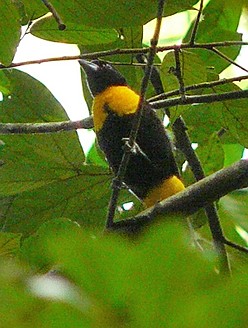 Identification. The Gola Malimbe is a restricted range species that was described as recently as 1974. The Gola Malimbe (photo above) is the only ploceid in the Upper Guinea high forest that has a yellow breast, black belly and yellow undertail-coverts.The nape is yellow in the male and black in the female. The immatures is greyer, with some yellow on the head, and a pale bill. The female Gola Malimbe has a yellow breast while female Rachel’s Malimbe has a yellow breast tinged with orange (and ranges do not overlap). Distribution. Three Gola Malimbe populations are known: in eastern Sierra Leone (Gola Forest) and adjacent western Liberia; in eastern Liberia and adjacent western Ivory Coast, and a recently found population in south-eastern Guinea (see map above, based on Birds of Africa). No races are recognised, but the Gola Malimbe has also erroneously been described as M. golensis. Habitat. The Gola Malimbe inhabits the middle storey of primary lowland rain-forest. It is also found in logged high forest and in mature secondary forest. The species is solitary, or found in small groups, and usually occurs in mixed-species foraging flocks through the year. Food. The Gola Malimbe feeds on insects up to 3 cm long, including grasshoppers and mantids. It forages actively, by gleaning green leaves and horizontal twigs for insects. It also investigates vertical twigs and liana-covered branches. The Gola Malimbe rarely probes in dry, rolled leaves. Foraging is usually between 8 and 22m above the forest floor. Breeding. The Gola Malimbe is probably monogamous. It is a solitary nester, and nest building is co-operative. The male sings and displays by facing the female, with the yellow breast and undertail-covert feathers lifted. 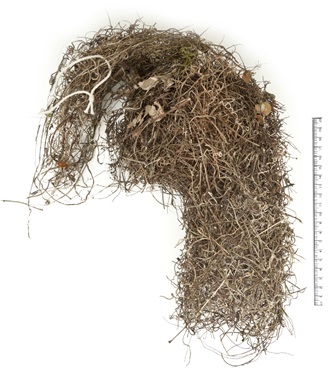 The nest resembles an inverted sock having a globular chamber and tubular entrance (about 25 cm) pointing down. The nest is suspended from the tip of vertically hanging lianas. The nest is sited between 8 and 21 m above the ground. Several Gola Malimbes from a mixed-species foraging flock will visit a nest site several times a day at irregular intervals; some will weave whilst others fly to and fro with building material and wait for a turn to build. Up to five individuals work on a nest simultaneously, with males tending to work on the attachment and outside of the nest, and females working mainly on the inside and on the entrance spout. There is no information on the eggs. Three or more individuals may feed young when a foraging flock passes an active nest. |
The above is based on Weaver Wednesday, a weekly series about weaver species.
This species text first appeared as Weaver Wednesday [96]: Gola Malimbe on 2014-04-16
2. Breeding facts
| Pair bond Presumed monogamous Breeding season Nest site Nest building Colony size Clutch size Egg colour Egg size Incubation Chicks and nestling period |
Breeding information based on Handbook of the Birds of the World, Vol. 15.
3. Photos of Weaver Nests
No records yet – be the first to submit a PHOWN record!