
Weaver species list / RELATED SPECIES: Bar-winged Weaver / Brown-capped Weaver / Dark-backed Weaver / Golden-naped Weaver / Maxwell’s Black Weaver / Olive-headed Weaver / Preuss’s Weaver / Red-bellied Malimbe / Red-headed Malimbe / Red-headed Weaver / Usambara Weaver / Yellow-capped Weaver / Yellow-legged Weaver / Yellow-mantled Weaver
IUCN: Least concern Discovery: 090
Categories: nuthatch, fruit
Discovery
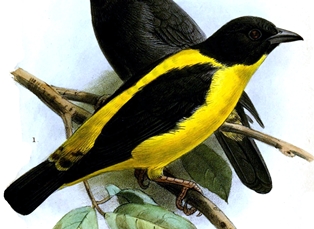  
IntroductionThe Brown-capped Weaver was formally described by Richard Bowdler Sharpe, an English zoologist and ornithologist who worked as curator of the bird collection at the British Museum of natural history.The Brown-capped Weaver was collected by Frederick John Jackson, an English administrator, explorer and ornithologist. In 1889 Jackson led an expedition designed to open up the regions between Mombasa and Lake Victoria, which was largely unknown to Europeans at that time, and if possible to obtain news of Emin Pasha. He travelled to Lake Victoria and then went north and east to travel around the lake to Mt Elgon. Mount Elgon is an extinct shield volcano on the border of Uganda and Kenya, and the mountain’s highest point, named “Wagagai”, is located within the country of Uganda. Jackson went further north past Mt Elgon on the eastern (Kenyan) side but had to return when he encountered hostile tribes. He used the opportunity to climb Mt Elgon (from the north side) and collect new bird species. He reached the crater at the top on 17 Feb 1890, and camped there for the night. While on the slopes of Mt Elgon, he collected the female of the Brown-capped Weaver. The collection was sent to Sharpe, who wrote up several new species. He named this weaver “insignis” (ie notable) as the plain yellow back was unlike the back colour of any other weaver he knew. The first illustration of the Brown-capped Weaver was the female type specimen, published by Sharpe (1891). The next illustration was of an adult male in Sjostedt (1895), considered to be a new species at the time. Scientific citationSycobrotus insignis Sharpe 1891b, Ibis, p.117, pl. 6, fig. 1, Mt. Elgon, Uganda. Meaning of namesinsignis, Latin: notable, extraordinary, remarkable. First English nameYellow-bodied Black-winged Weaver (Shelley 1905b). Alternate namesCameroon Brown-capped Weaver, Chestnut-capped Weaver, Chestnut-headed Yellow-backed Weaver, Congo Brown-capped Weaver, Nairobi Brown-capped Weaver, Yellow-bodied Black-winged Weaver. CollectorFrederick John Jackson. Date collectedFeb 1890. Locality collectedMt. Elgon, Uganda. Type specimensThe type is in the Bristish Museum (BM 1893.12.1.6). |
The above is based on Weaver Wednesday 2, a weekly series about the discovery of each weaver species.
This species text first appeared as Weaver Wednesday [207] – Discovery [90]: Brown-capped Weaver on 2016-06-01
1. Basic biology
Male
Female
| Identification. The Brown-capped Weaver Ploceus insignis is one of the ‘nuthatch’ (bark-gleaning) weavers. The Brown-capped Weaver has a yellow body with plain black wings and tail. The male has a black face and throat with a chestnut crown and nape. The female has the entire head black. The similar Preuss’s Weaver has a chestnut wash on the breast and its female has a yellow crown. The Yellow-capped Weaver differs from the Brown-capped Weaver in having a black rump.
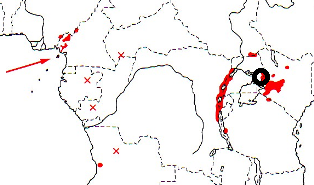
Distribution. The Brown-capped Weaver occurs in scattered localities in West Africa from Nigeria to Angola. It also occurs along the Albertine Rift and in East Africa, especially western Kenya (see map above, based on Birds of Africa). Its distribution is very patchy, but is still widely distributed, but is uncommon in Angola and Gabon. Several subspecies of the Brown-capped Weaver have been described but are no longer recognised. Habitat. The Brown-capped Weaver inhabits tall montane forest, a vulnerable habitat type. It also occurs in bamboo forest, secondary forests, gallery forest and coffee plantations. It is often found in areas with an open canopy and dense understorey vegetation.  Food. The Brown-capped Weaver feeds mainly on insects, such as caterpillars, and fruit. It moves at all levels in forests, hopping along boles and thicker lateral branches in the canopy. The The Brown-capped Weaver probes exposed bark and epiphytes with its bill. It feeds solitarily, in pairs, or in family parties of three or four individuals; it also joins mixed-species flocks. Breeding. The Brown-capped Weaver is probably monogamous, and is a solitary nester. The male uses a short courtship song away from the nest, and also sings when the female enters the nest. The nest is retort-shaped, and may have a long entrance tube. The nest is attached to the underside of a branch or at the tip of a branch, often above a forest track or clearing. The clutch is 2 eggs, which are pale blue with a few brown spots. |
The above is based on Weaver Wednesday, a weekly series about weaver species.
This species text first appeared as Weaver Wednesday [78]: Brown-capped Weaver on 2013-12-11
2. Breeding facts
| Pair bond Presumably monogamous Breeding season Nest site Nest building Colony size Clutch size Egg colour Egg size Incubation Chicks and nestling period |
Breeding information based on Handbook of the Birds of the World, Vol. 15.
3. Photos of Weaver Nests
 Vm 13809 |
Vm 13807 |
Thumb-nails of recent PHOWN records