
Weaver species list / RELATED SPECIES: Black Bishop / Black-winged Bishop / Fire-fronted Bishop / Golden-backed Bishop / Northern Red Bishop / Red-collared Widowbird / Southern Red Bishop / Yellow-crowned Bishop / Zanzibar Bishop
IUCN: Least concern Discovery: 001
Categories: red bishops, Linnaeus, pest
Discovery


IntroductionLinnaeus thought this species came from India, or the [East] Indies (“in Indiis”), a common mistake in his day, as the ship bringing this specimen probably came from the far East but stopped at African ports along the way, where African specimens could have been added to the cargo. Gyldenstolpe (1924) first noticed the error, and restricted the type locality to Senegal as the type specimen matched other specimens from Senegal.Linnaeus noted the source of the type specimen as “mus ad fr”, ie. the Museum Adolphi Friderici, a collection maintained by the King of Sweden, Adolf Fredrik. Swainson (1837) obtained described a specimen from Senegal as a new species (Crimson-crowned Weaver Euplectes flammiceps), but this was later discovered to be the same species as the Black-winged Bishop. Nevertheless, his painting is the first published illustration of this species, many decades after Linnaeus first described it. Scientific citationLoxia hordeacea Linnaeus 1758a Syst. Nat., ed. 10, p173 ‘in Indiis’, errore = Senegal, vide Gyldenstolpe 1924. Meaning of nameshordeaceus (Latin) – of barley; referring to its diet. First English nameYellow-rumped Grosbeak (Latham 1783). Alternate namesFire-crowned Bishop. CollectorUnknown, but kept in the Museum Adolphi Friderici. Date collectedBefore 1754, since Linnaeus studied the collection from 1751-1754. Locality collectedUnknown, type locality restricted to Senegal. Type specimensThe type is in the Swedish Museum of Natural History (Naturhistoriska riksmuseet) in Stockholm. Modern photos of the type are at here. |
The above is based on Weaver Wednesday 2, a weekly series about the discovery of each weaver species.
This species text first appeared as Weaver Wednesday [118] – Discovery [1]: Black-winged Bishop on 2014-09-17
1. Basic biology
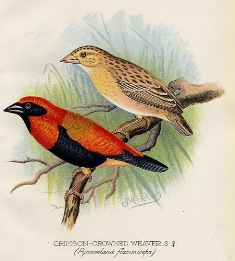 from Butler 1899 Identification This species was described by Linnaeus, based on a specimen from Senegal, and photos of the holotype may be viewed here. Distribution Habitat Food
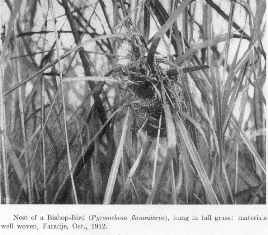 Breeding The nest resembles the nest of the Southern Red Bishop but has a larger side entrance and distinct overhanging porch. The nest is placed in tall grass or coarse vegetation, 0.8-3.0m above ground. It is usually supported by grass stems on either side of the large entrance. During droughts, the first nests are built 3 weeks later than average, and more nests are built in trees than in grass. This species seldom breeds in colonies, and is often solitary or with 2 males close together. The male constructs the nest, and may work on more than one at a time. The female lines an accepted nest with fine grass. Only the female incubates the eggs and feeds the chicks. Nests may be parasitized by the Diederik Cuckoo Chrysococcyx caprius. |
The above is based on Weaver Wednesday, a weekly series about weaver species.
This species text first appeared as Weaver Wednesday [58]: Black-winged Bishop on 2013-07-24
2. Breeding facts
| Pair bond Polygynous, with up to four females per male Breeding season Nest site Nest building Colony size Clutch size Egg colour Egg size Incubation Chicks and nestling period |
Breeding information based on Handbook of the Birds of the World, Vol. 15.
3. Photos of Weaver Nests
 Vm 5770 |
Thumb-nails of most recent PHOWN records