
Weaver species list / RELATED SPECIES: Asian Golden Weaver / Baya Weaver / Black-throated Weaver / Finn’s Weaver / Streaked Weaver
IUCN: Near threatened Discovery: 014
Categories: Asian, IUCN, white eggs
Discovery
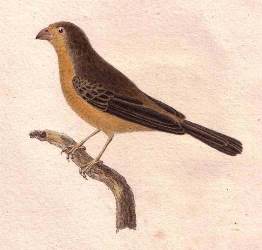
IntroductionThe Asian Golden Weaver was formally named by Anders Erikson Sparrman, a Swedish naturalist. Although Sparrman sailed around the world with James Cook, starting from Cape Town, on Cook’s second expedition to the Pacific (1772-1775), they did not visit islands as far north as Sumatra. After the voyage Sparrman returned to Cape Town in July 1775 and practiced medicine. In 1776 he returned to Sweden and published a Catalogue of the Museum Carlsonianum (1786-89), in which he described many of the specimens he had collected in South Africa and the South Pacific, some of which were new to science. He wrote a Latin description of the Asian Golden Weaver.Sparrman described and painted the Asian Golden Weaver, and listed the collector as Claes Fredrik Hornstedt, a Swedish naturalist. Hornstedt visited Batavia [=Jakarta] in Java from July 1783 to July 1784. He returned to Sweden with a large collection of natural history objects. In Sweden he replaced Sparrman as curator of the museum of the Royal Academy of Sciences (KVA), Stockholm, in 1787-88 (Rookmaaker 1989). Rookmaaker suggested that Hornstedt did not visit Sumatra, but received specimens from local collectors, even though he presents no evidence of this and Sumatra is relatively close to the adjacent island of Java. Latham (1801) noted that a bird was brought alive from Sumatra and kept by Count Carlson (in Museum Carlsonianum). Scientific citationLoxia hypoxantha Sparrman 1788 Mus. Carls., fasc., 3, p.71 Sumatra. Meaning of nameshypoxanthus (Greek) = hupo-, beneath; xanthos, golden or yellow [ie underparts golden]. First English nameSumatran Grosbeak (Latham 1801). Alternate namesNone. CollectorClaes Fredrik Hornstedt. Date collected1783-84, when Hornstedt lived in Java. Locality collectedSumatra. Type specimensNo type specimens known to survive, but the painting of Sparrman serves as a type. |
The above is based on Weaver Wednesday 2, a weekly series about the discovery of each weaver species.
This species text first appeared as Weaver Wednesday [131] – Discovery [14]: Asian Golden Weaver on 2014-12-17
1. Basic biology
| Identification. The Asian Golden Weaver Ploceus hypoxanthus is a Near Threatened species. The breeding male is generally bright yellow with a black mask (diagnostic in Asia). Females, non-breeding males and young birds are dull coloured and difficult to distinguish from the Baya Weaver, but has a thicker bill.
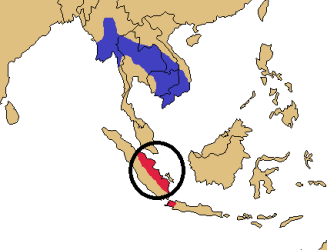
Distribution. There are two subspecies of the Asian Golden Weaver, with disjunct distributions (see map above, based on Handbook of the Birds of the World, Vol. 15: The Asian Golden Weaver was formerly more widespread in Sumatra and Java, but is now localized and uncommon. Its population is showing a continued decline throughout its range as wetlands are converted to agriculture. There is also direct persecution and capture of these weavers for the bird trade, and colonies are often robbed and destroyed by people. The oldest bird is 11 years (see here). Habitat. The natural habitats of the Asian Golden Weaver are subtropical or tropical seasonally wet or flooded lowland grassland, swamps, and arable land. Food. The Asian Golden Weaver feeds mainly on seeds, and even during breeding insects were only 7% of their diet. Breeding. The Asian Golden Weaver is apparently monogamous, and perhaps occasionally polygynous. It breeds in small colonies. The nest is initially built by the male, and completed with assistance of the female. The nest is a rounded structure with a side entrance, and woven from thin strips of grass or palm leaves. Nests are firmly attached to vegetation over water or very swampy ground, often less than 1m above the surface, usually in reeds or bulrushes. Sometimes nests are placed in trees or shrubs, and then higher than 2 m above the ground. There are several records of nests built close to hornet nests or near biting ants. 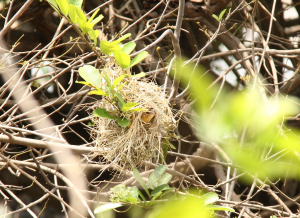 
The clutch is 2 eggs, rarely 3. Incubation seems to be by the female only. Chicks are fed mainly by female (most often by regurgitation), and rarely by the male. There is no information on incubation and nestling periods. |
The above is based on Weaver Wednesday, a weekly series about weaver species.
This species text first appeared as Weaver Wednesday [39]: Asian Golden Weaver on 2013-03-13
2. Breeding facts
| Pair bond Apparently monogmous, perhaps occasionally polygynous Breeding season Nest site Nest building Colony size Clutch size Egg colour Egg size Incubation Chicks and nestling period |
Breeding information based on Handbook of the Birds of the World, Vol. 15.
3. Photos of Weaver Nests
< Vm 5292 |
 Vm 1255 |
 Vm 1254 |
 Vm 1253 |
Thumb-nails of most recent PHOWN records