
Weaver species list / RELATED SPECIES: Bocage’s Weaver / Cape Weaver / Chestnut Weaver / Fox’s Weaver / Heuglin’s Masked Weaver / Speke’s Weaver
IUCN: Least concern Discovery: 080
Categories: acacias, fruit, baobab, pest, Nest use
Discovery
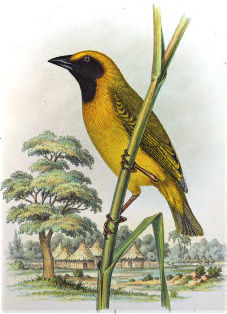 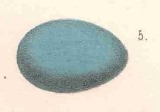 
IntroductionHeuglin’s Masked Weaver was formally described by Anton Reichenow, a German ornithologist and herpetologist.Heuglin’s Masked Weaver was collected by Martin Theodor von Heuglin, a German explorer and ornithologist in north-eastern Africa. He collected a large number of birds, including new species, in East Africa. In 1861 Heuglin led an expedition, starting from Massawa in Eritrea, towards Khartoum via a wide detour through Ethiopia. In 1863 Heuglin continued from Khartoum to explore a great part of the Bahr-el-Ghazal river in South Sudan. The Bahr el Ghazal, meaning “sea of gazelles”, is a tributary of the White Nile. Heuglin described this species in 1864, soon after returning to Europe from NE Africa. However, he named it as Textor atrogularis (“black-throated”), a name which had already been used for the Black-necked Weaver by Voigt (1831), a name no longer valid for the latter species, but nevertheless one that cannot be used for Heuglin’s Masked Weaver. This error was realised by Reichenow, who re-named Heuglin’s Masked Weaver in honour of Heuglin. The first illustration of the Heuglin’s Masked Weaver was of the type, published by Heuglin (1869), repeated in 1871. The second illustration for the species was of the egg, in Heuglin (1873). Scientific citationPloceus heuglini Reichenow 1886, Zool. Jahrb. I, p.147, Bahr-el-Ghazal, Sudan. Meaning of namesheuglini, After Theodor von Heuglin (1824-1876) German explorer, ornithologist, and author. First English nameHeuglin’s Masked-Weaver (Shelley 1905). Alternate namesPlain-backed Masked Weaver, Senegal Masked Weaver. CollectorTheodor von Heuglin. Date collectedAug 1863. Locality collectedGazellenfluss=Bahr el Ghazal, South Sudan. Type specimensThere are at least one type (in the Leiden Museum), but there may be more syntypes. |
The above is based on Weaver Wednesday 2, a weekly series about the discovery of each weaver species.
This species text first appeared as Weaver Wednesday [197] – Discovery [80]: Heuglin’s Masked Weaver on 2016-03-23
1. Basic biology
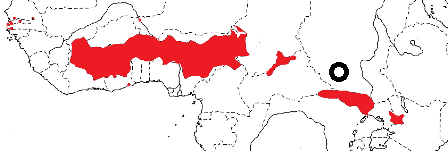
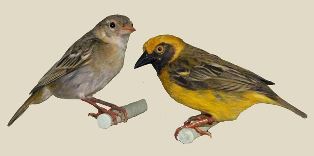 figure from Wikipedia Identification. Heuglin’s Masked Weaver breeding male has a pale eye, and a black mask that extends to a narrow point on its breast. The crown is golden yellow with no black on the forehead, and the back is plain green. It does not overlap with the similar but larger Speke’s Weaver. The Lesser Masked Weaver also has a pale eye but the head is black from the forehead to the mid-crown. The Vitelline Masked Weaver has a red eye in both sexes, a chestnut wash on the crown (male), and less yellow underparts (female and non-breeding male). The female Heuglin’s Masked Weaver is very similar to the female Lesser Masked but has pink, not grey, legs. Distribution. Heuglin’s Masked Weaver is found in the woodland savanna belt from southern Senegal and Gambia, across West Africa to extreme western Kenya (see map above based on Birds of Africa). No subspecies are recognised. Habitat. Heuglin’s Masked Weaver inhabits savanna woodland, coastal thickets, secondary scrubland and is found around farms and villages. It generally prefers dry, tall woodland areas. Heuglin’s Masked Weaver moves away from its breeding areas after nesting and movements may be related to regional rainfall patterns. Food. Heuglin’s Masked Weaver feeds mainly on arthropods, including spiders, caterpillars, beetles, dragonflies, grasshoppers. It also feeds on fruits and grass seeds. In Ivory Coast, its diet was estimated as 70% arthropods, 10% fruit and 20% seeds by weight. Heuglin’s Masked Weaver examines leaves and flowers, apparently searching for insects.  Breeding. Heuglin’s Masked Weaver is polygynous. It is a colonial or solitary nester, typically having up to 15 nests in a colony. The same sites are used annually, and sites are usually away from water. Heuglin’s Masked Weaver may form mixed colonies with other weaver species. The nest is kidney-shaped, with a tunnel up to 20 cm long extending from the entrance. The nest is placed in a tree, or often attached to telephone lines with each nest woven to the wire throughout its width for additional stability. The nest is coarsely woven by the male using strips of grass or grass stems, and may be completed in a day. The male displays by quivering his wings and tail, or beating his wings, while hanging below a nest. If a female accepts a nest, she lines it with downy flowerheads of grasses. The male does not strip leaves from the vegetation around the nest. Heuglin’s Masked Weavers often choose protected nest sites. One colony overhung the entrance of a busy rest house in Nigeria. Nests may be attached to the base of the nests of an Augur Buzzard Buteo auguralis, Crowned Hawk-eagle Stephanoaetus coronatus, African White-backed Vulture Gyps africanus, Marabou Leptoptilus crumeniferus or Abdim’s Stork Ciconia abdimii. 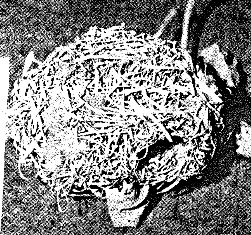 Alternatively, nests are often associated with stinging or biting insects like mud wasps Megachile, paper wasps Polistes fastidiosus and Ropalidia cincta, bees Apis, and the red weaver ant Oecophylla smaragdina. The clutch is 2-4 eggs, and the eggs are plain turquoise-blue, or pale blue with very fine brown spots. The female incubates the eggs and feeds the chicks. Some nests are parasitized by the Diederik Cuckoo Chrysococcyx caprius in Mali.Old nests of the Heuglin’s Masked Weaver may be taken over by the Cut-throat Finch Amadina fasciata, African Silverbill Euodice cantans, or Red-cheeked Cordon-bleu Uraeginthus bengalus. |
The above is based on Weaver Wednesday, a weekly series about weaver species.
This species text first appeared as Weaver Wednesday [69]: Heuglin’s Masked Weaver on 2013-10-09
2. Breeding facts
| Pair bond polygynous Breeding season Nest site Nest building Colony size Clutch size Egg colour Egg size Incubation Chicks and nestling period |
Breeding information based on Handbook of the Birds of the World, Vol. 15.
3. Photos of Weaver Nests
Vm 3725 |
Thumb-nails of recent PHOWN records