
Weaver species list / RELATED SPECIES: Black Bishop / Black-winged Bishop / Fire-fronted Bishop / Golden-backed Bishop / Northern Red Bishop / Red-collared Widowbird / Southern Red Bishop / Yellow-crowned Bishop / Zanzibar Bishop
IUCN: Least concern Discovery: 076
Categories: red bishops
Discovery
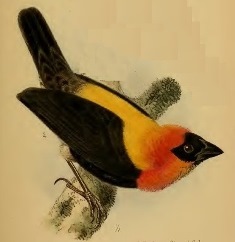
IntroductionThe Black Bishop was formally described by Jean Louis Cabanis, a German ornithologist and director of the Berlin University Museum, who described several other weavers.The Black Bishop was collected by Otto Schutt, a German railway engineer who worked in various countries, being in Angola in 1878-1879, where he collected many birds. Paul Gierow accompanied Schutt on his travels, and Cabanis named the bishop after Gierow, as Cabanis had already named other bird species after Schutt (eg. Black-billed Turaco Tauraco schuetti). Bocage (1893) restricted the type locality from Angola to Cuango River, Malanje Province. This was not based on ornithological publications or from label data, but Bocage drew on his regional knowledge and possible routes taken by Schutt. Schutt wrote a book on his travels in Angola (Reisen Im Sudwestlichen Becken Des Congo). The first illustration of the Black Bishop was published in Cabanis (1880). The second illustration was published by Fischer (1884), of subspecies friederichseni (see Biology of the Black Bishop). Scientific citationEuplectes Gierowii Cabanis 1880 Ornithologisches Centralblatt, 5(1), p. 6, Angola. Meaning of namesgierowii, After Paul Gierow. First English nameAnsorge’s Bishop-bird (Shelley 1905). Alternate namesAngola Black-Bishop, Ansorge’s Bishop-bird, Gierow’s Bishop-bird, Massailand Bishop, Northern Black-Bishop, Southern Black-Bishop. CollectorOtto Schutt and Paul Gierow. Date collected1878 or 1879. Locality collectedCuango River, Malanje Province, Angola. Type specimensThe type specimen is in the Berlin Museum (ZMB 24389). |
The above is based on Weaver Wednesday 2, a weekly series about the discovery of each weaver species.
This species text first appeared as Weaver Wednesday [193] – Discovery [76]: Black Bishop on 2016-02-24
1. Basic biology
Male
Female
Identification. The Black Bishop is a relatively poorly known species, with scattered populations. It is the largest and least common of the red and black bishops (see also Southern Red Bishop, Black-winged Bishop and Zanzibar Bishop). The breeding male is distinguished from the sympatric Black-winged Bishop by a mainly black head, orange-yellow back, and black rump; the orange breast-band width varies with race. The female and non-breeding male are blacker above than other bishops (especially male), heavily streaked, with a broad creamy supercilium – other bishop species are smaller, females paler, and not spotted below.
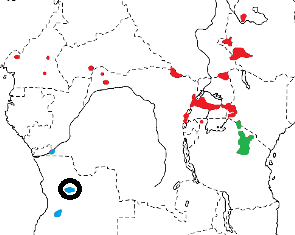
Distribution. The Black Bishop is found in widely separated populations which form 3 subspecies (see map above, based on Birds of Africa): Habitat. The Black Bishop inhabits tall grassland, in swampy or drier bushy areas, and also scrub and sugar cane. In Kenya it is found in areas with more than 1000 mm annual rainfall, whereas in Tanzania it occurs in drier country. It is often found with the Black-winged Bishop in East Africa. Food. The diet of the Black Bishop includes seeds and insects, the latter including winged ants and alate termites. It forages mainly in pairs and small groups, and joins mixed species flocks in the non-breeding season. Breeding. The Black Bishop is polygynous, and the male holds a territory containing three or four nests. The nest is coarsely woven, with a large entrance high on one side. It is built with grass, and lined with grass seedheads. The nest is usually placed above the above ground in elephant grass, attached to one vertical stalk and some leaf blades, although one nest was in the fork of a shrub. The clutch is 2-4 eggs, and the eggs are bright blue, sometimes with fine black or red-brown spotting. Nothing else is known about its breeding habits. |
The above is based on Weaver Wednesday, a weekly series about weaver species.
This species text first appeared as Weaver Wednesday [61]: Black Bishop on 2013-08-14
2. Breeding facts
| Pair bond Polygynous Breeding season Nest site Nest building Colony size Clutch size Egg colour Egg size Incubation Chicks and nestling period |
Breeding information based on Handbook of the Birds of the World, Vol. 15.
3. Photos of Weaver Nests
 Vm 9572 |
 Vm 9286 |
Thumb-nails of most recent PHOWN records