
IUCN: Least concern Discovery: 084
Categories: Brachycope & Pachyphantes, palm
Discovery
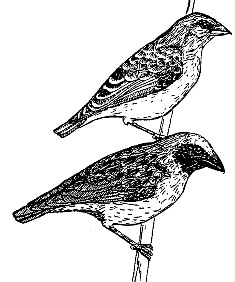 figure from Bannerman (1949)
IntroductionThe Bob-tailed Weaver was formally described by Anton Reichenow, a German ornithologist and herpetologist.The Bob-tailed Weaver was collected by Friedrich Bohndorff, a German researcher and ornithologist. Bohndorff took part in the Austro-Hungarian Congo Expedition, 1885-87. It was led by Oskar Lenz, a German-Austrian geologist. They crossed the African continent from the Atlantic, following the Congo River and then continuing eastward to the Indian Ocean. The aims were to survey the economic trade situation in the newly established Congo Free State, and to map the Congo-Nile watershed between the Congo and Nile Rivers. 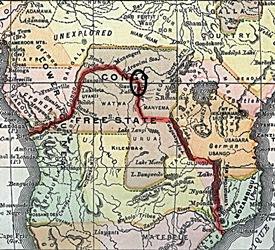 In February 1886 the expedition reached the Stanley Falls (named after Henry Morton Stanley who reached the falls in January 1877, 9 years prior to Bohndorff). Here Bohndorff collected a male Bob-tailed Weaver and this type specimen is in the Berlin Museum. The Bob-tailed Weaver occurs along much of the Congo River but Bohndorff missed it earlier, perhaps not having much time for collecting before reaching the Falls. Bohndorff also collected a new subspecies of the Village Weaver at Stanley Falls and Reichenow later named the subspecies after Bohndorff.The first illustration of the Bob-tailed Weaver was published by Bannerman (1949), over 60 years after it was first described. The next illustration to be published was by Schouteden (1958). Scientific citationPloceus anomalus Reichenow 1887, Journ. f. Orn., 35, p.214, Stanley Falls. Meaning of namesanomala, Latin: anomalus, irregular, anomalous (Greek: Anomalos, irregular, strange). First English nameAnomalous Weaver (Shelley 1905). Alternate namesAnomalus Bishop. CollectorFriedrich Bohndorff. Date collectedFeb 1886. Locality collectedStanley Falls, Democratic Republic of the Congo. Type specimensThe type is in the Berlin Museum (ZMB_B.20007). 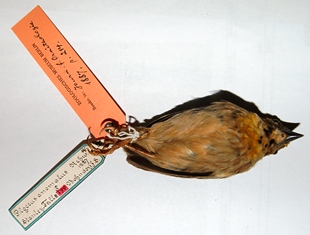 |
The above is based on Weaver Wednesday 2, a weekly series about the discovery of each weaver species.
This species text first appeared as Weaver Wednesday [201] – Discovery [84]: Bob-tailed Weaver on 2016-04-20
1. Basic biology
Male
Female
| Identification. The Bob-tailed Weaver is in the monotypic genus Brachycope. The meaning of the genus is “short – appearance”, i.e. refering to the small size and very short tail of the species.The adult male has a black mask surrounded by some yellow on the head and breast. The female and non-breeding male are brownish with uniform buff underparts. The short tail and brownish plumage give the impression of juveniles, even in adult birds.
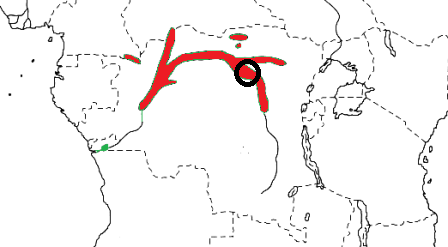
Distribution. The Bob-tailed Weaver has been recorded along the Congo River, and other rivers in DRC, Cameroon, Republic of the Congo and Central African Republic. The distribution map (above) is based on Birds of Africa. Interestingly, the Congo Sunbird Cinnyris congensis has a similar range. There are two recent records from Angola, one very far out of range in the south-east, and one from northern Angola. No subspecies have been described for this species. Habitat. The Bob-tailed Weaver is found in grassy clearings near large rivers in rain-forest. Food. The Bob-tailed Weaver forages on the ground, probably feeding mainly on seeds and some insects. It uses clearings created for cultivation, and is often found near villages. Breeding. The Bob-tailed Weaver is a solitary breeder and is probably monogamous. The nest is a sphere with a side entrance, woven of grass strips. The nest is placed in bushes, small trees and oil palms. The eggs are uniform dark grey, different to the colour of most weaver eggs, and not a common colour for bird eggs. A quick search of the internet and a weaver bibliography has not revealed any illustration of the nest of this species (though there must be one somewhere!). |
The above is based on Weaver Wednesday, a weekly series about weaver species.
This species text first appeared as Weaver Wednesday [14]: Bob-tailed Weaver on 2012-09-19
2. Breeding facts
| Pair bond appeas to be monogmous Breeding season Nest site Nest building Colony size Clutch size Egg colour Egg size Incubation Chicks and nestling period |
Breeding information based on Handbook of the Birds of the World, Vol. 15.
3. Photos of Weaver Nests
No records yet – be the first to submit a PHOWN record!