
The Asian weavers
There are 5 Asian weaver species and they are all in the genus Ploceus. The Baya Weaver is the most widespread and common species. Two Asian weaver species have IUCN threat status as shown below. The Asian weavers are found in savanna, grassland and swampy areas – no Asian weaver species occupy forests. The Asian weavers feed on seeds, insects and sometimes nectar. All five species lay plain white eggs.
| VULNERABLE Finn’s Weaver (or Yellow Weaver) Ploceus megarhynchus |
NEAR THREATENED Asian Golden Weaver Ploceus hypoxanthus |
| LEAST CONCERN Baya Weaver Ploceus philippinus |
LEAST CONCERN Black-throated Weaver (or Bengal Weaver) Ploceus benghalensis |
| LEAST CONCERN Streaked Weaver Ploceus manyar 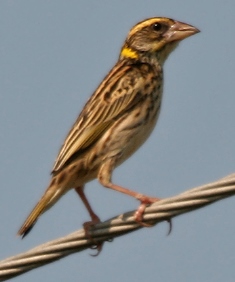 |
Discovery of the Asian weavers
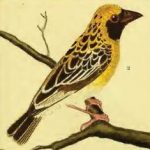
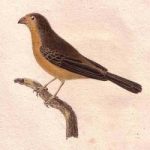
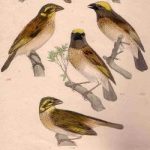
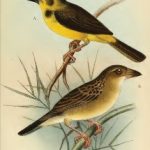
The 5 Asian weavers were described over 111 years, by 4 different authors, from 2 countries. To read more about the discovery of each of these species, click on the name. The first time each species was illustrated in western literature is shown below (for the Streaked Weaver there was an earlier line drawing of its head, but the first illustration of an adult is given here).
| Original name | Author and year | Type locality |
| Loxia benghalensis
Black-throated Weaver |
Linnaeus 1758 | Bay of Bengal, India |
| Loxia philippina
Baya Weaver |
Linnaeus 1766 | Pondicherry, India |
| Loxia hypoxantha
Asian Golden Weaver |
Sparrman 1788 | Sumatra, Indonesia |
| Fringilla Manyar
Streaked Weaver |
Horsfield 1821 | Java, Indonesia |
| Ploceus megarhynchus
Finn’s Weaver |
Hume 1869 | “The Terai”, Kaladingee, India |

Nesting in Asian weavers
The 5 Asian weavers weave their nests as other true weavers do, and the male does most of the building, and females line the nests. Asian weavers may use mud and flowers in their nests, and various theories have been proposed to explain this – the most likely reason is that the male uses mud to attach flowers to the nest. Some differences in the nesting traits of the 5 species are listed in the table below.
| Trait | Asian Golden W | Baya W | Bengal W | Finn’s W | Streaked W |
| Pair bond | Monogamous | Polygnous | Polygnous | Polygnous | Monogamous |
| Colonial | Small | Colonial | Single, small | Colonial | Colonial |
| Nest site | Reeds in swamps | Trees, esp palm & acacia |
Reeds, some trees | Trees, reeds | Reeds, trees |
| Nest tunnel | no | long | long | no | short |
| Attachment | supported | pendant | pendant (tree), supported (reed) |
supported | supported |
| Mud used | no | rarely | often | rarely | rarely |
Photos of nesting
 |
 |
| Baya Weaver colony – note pendant (hanging) nests, with long entrance tubes | Asian Golden Weaver colony – note supported nests, no long entrance tubes |
| Black-throated Weaver colony | Finn’s Weaver colony |
| Streaked Weaver nest |
PHOtos of Weaver Nests in Asia
PHOWN (PHOtos of Weaver Nests) is a Virtual Museum, citizen science project of the Animal Demography Unit, to collect and monitor breeding distributions and colony sizes of weaver birds globally. As of 9 June 2016, there are 26 PHOWN records of Asian weavers, and 18 with colony size information. The statistics of colony sizes from PHOWN are as follows:
| Species | Min | Mean | Max | n |
| Asian Golden Weaver | 14 | 17.7 | 23 | 3 |
| Baya Weaver | 3 | 14.4 | 70 | 15 |
Many more records are needed to obtain better data on current breeding ranges, nest sites, and colony sizes of the Asian weavers. Please consider taking part in PHOWN – To take part, register and upload records at Virtual Museum (read the “How to” pdf for help).
