
IUCN: Least concern Discovery: 036
Categories: wetland, fruit, frogs, nectar, pest, Nest use, Amblyospiza
Discovery
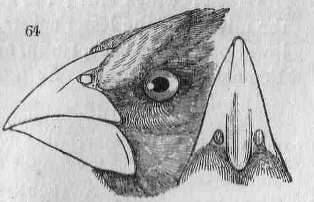 figure from Swainson 1838 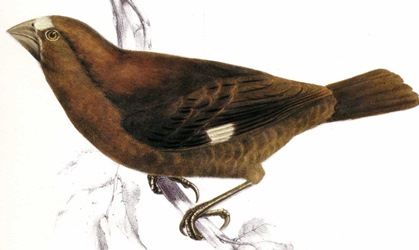 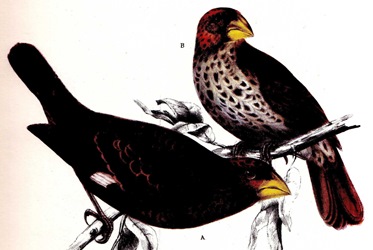 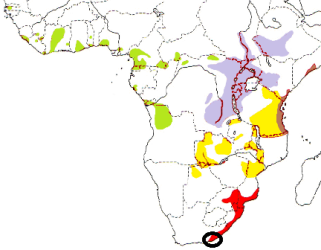
IntroductionThe Thick-billed Weaver was formally described by Nicholas Aylward Vigors, an Irish zoologist and politician. Vigors was a co-founder of the Zoological Society of London in 1826, and its first secretary until 1833.The Thick-billed Weaver specimen was presented to the Zoological Society of London by Henry Ellis, an English librarian at the British Museum. It is not known from whom Ellis obtained these specimens. Vigors described nine new species from the Ellis collection and the specimens were all believed to have come from Algoa Bay and surroundings in the Eastern Cape. Two species, however, the Purple-crested Turaco Tauraco porphyreolophus and the Spotted Thrush Zoothera guttata, have their southern limits further north in the Transkei (and may have come from Durban), but the rest of the specimens probably did originate from the Algoa Bay area. The first illustration of a Thick-billed Weaver is in Swainson (1838), showing a line drawing of the very heavy bill of a male. A few years after this species was first described, Andrew Smith found this species in 2 places: in the Eastern Cape forests (probably not too far from Grahamstown, as Smith was based there in his early years in South Africa) and around Durban (Port Natal) in 1832. Smith commisioned the first colour illustrations of the The Thick-billed Weaver – these were published as 2 plates in Smith (1840), and painted by George Henry Ford. Scientific citationPyrrhula albifrons Vigors 1831; Proc. Zool. Soc. London, p.92 1831 Algoa Bay, eastern Cape. Meaning of namesalbifrons Latin: albus, white; frons, the forehead, brow. First English nameWhite-fronted Grosbeak (Gurney 1860). Alternate namesAbyssinian Grosbeak Weaver, Angola Grosbeak Weaver, Ashanti White-fronted Grosbeak, Black Swamp Weaver, Cameroon Grosbeak Weaver, Cavort chewer, East Coast Grosbeak Weaver, Grosbeak Weaver, Hawfinch Weaver, Kenya Grosbeak Weaver, The white-headed Coryphegnathus, White Nile Grosbeak Weaver, White-fronted Grosbeak, White-fronted Weaver. CollectorUknown. Date collectedBefore 1831. Locality collectedAlgoa Bay. Type specimensThe type specimen is not in the British Museum (Warren 1971), and is thus probably lost. |
The above is based on Weaver Wednesday 2, a weekly series about the discovery of each weaver species.
This species text first appeared as Weaver Wednesday [153] – Discovery [36]: Thick-billed Weaver on 2015-05-20
1. Basic biology
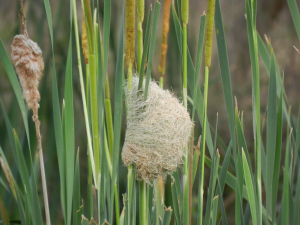
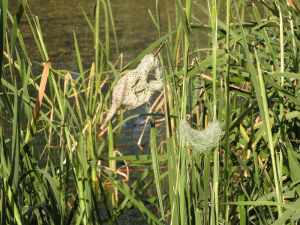
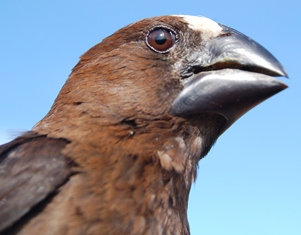 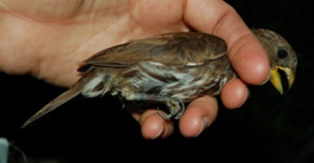 Identification. The Thick-billed Weaver Amblyospiza albifrons is in a monotypic genus (only one species in the genus), namely Amblyospiza, this name meaning “blunt, finch”, referring to its amazingly heavy bill. The male has a black bill, white forehead (photo) and conspicuous white patches in its wings; the rest of its plumage varies racially, from chestnut to black. The sexes are dissimilar, and the female has a yellow bill, brown upperparts, and underparts white heavily striped with sepia. The juvenile resembles the female, but the bill is yellowish; immature males need 2 years to attain adult plumage. Distribution. The Thick-billed Weaver is widespread in sub-Saharan Africa and has five subspecies. This species is expanding its range, especially in the provinces around Gauteng in South Africa (see here). Habitat. The Thick-billed Weaver inhabits wetlands when breeding and forest edges when not breeding, and shows some local movements. It is a fairly common species locally. Food. The Thick-billed Weaver feeds on insects (including termites), berries and fruit, and hard-shelled seeds; also sunflower seeds. An adult in Kenya ate a small frog, and aquatic snails have been recorded in its diet.  Breeding. The nest of the Thick-billed Weaver is distinctive. It is compact, woven with thin strips of reeds, slung between upright stems of reeds. The nest is globe-shaped with a side entrance near the top. The fine material used lets a nest look neat, but actually the weave is very primitive. Initially the entrance is large, and reduced to a narrow opening if used for breeding. Colonies may be small with one male, or larger with several males, in a reed patch. This species is polygynous, the male attempting to attract several females. The mean clutch size 3 eggs, and the eggs are white to pink, spotted with red, purple and brown. Incubation is by the female, with long incubation spells of 33 minutes (and 12 minutes off the nest). The chicks are fed by the female (by regurgitation), and sometimes the male also feeds. Nest predators include the White-browed Coucal Centropus superciliosus, House Crow Corvus splendens, and Nile monitor Varanus niloticus. Old nests may be taken over by climbing mice, and used for breeding by the Zebra Waxbill Amandava subflava or Brown Firefinch Lagonosticta nitidula. |
The above is based on Weaver Wednesday, a weekly series about weaver species.
This species text first appeared as Weaver Wednesday [8]: Thick-billed Weaver on 2012-08-08
2. Breeding facts
| Pair bond Polygynous, male with up to six females, three nesting simultaneously on territory; also single nests and apparently monogamous pairs in areas of low density Breeding season Nest site Nest building Colony size Clutch size Egg colour Egg size Incubation Chicks and nestling period |
Breeding information based on Handbook of the Birds of the World, Vol. 15.
3. Photos of Weaver Nests
 Vm 29296 |
 Vm 29226 |
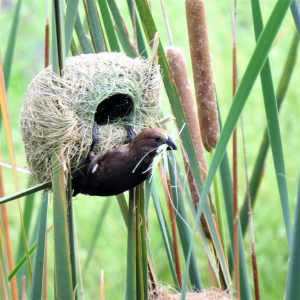 Vm 29206 |
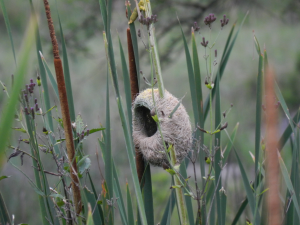 Vm 29195 |
 Vm 29125 |
 Vm 29055 |
Thumb-nails of recent PHOWN records