
Weaver species list / RELATED SPECIES: Black-billed Weaver / Black-chinned Weaver / Black-necked Weaver / Clarke’s Weaver / Lesser Masked Weaver / Little Weaver / Loanga Weaver / Slender-billed Weaver / Spectacled Weaver / Strange Weaver / Tanganyika Masked Weaver
IUCN: Least concern / Discovery: 034
Categories: long tube, , acacias, fruit, frogs, gum, nectar, Nest use, palm, double nests, Ploceus 6: ‘Hyphanturgus’
Discovery
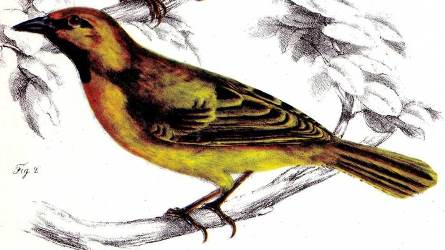 
IntroductionThe Spectacled Weaver was formally described by Sir Andrew Smith, a Scottish surgeon, naturalist, explorer and zoologist.Smith lived in South Africa from 1821 to 1837, mainly in Grahamstown and Algoa Bay (i.e. Port Elizabeth) in the Eastern Cape, and in Cape Town in the Western Cape (Kirby 1965). Smith’s type-localities are often imprecise because he was more interested in describing ranges than providing formal type-localities. Smith noted that the Spectacled Weaver was ‘Found in similar situations with the foregoing’, referring to Ploceus personatus = P. velatus for which the locality was given as ‘Found in the eastern districts of the Colony’. In Smith (1839) he described it as being ‘sparingly distributed over South Africa: more especially in the vicinity of the south-east coast’. Clancey (1952) restricted the type locality to Durban, KwaZulu-Natal, but Smith visited Durban for the first time only in 1832, four years later. Later, Clancey (1964) corrected this to the Eastern Cape and thereafter (1966) selected Grahamstown, Eastern Cape, as a type-locality because Smith was based there in his early years in South Africa. The first illustration of a Spectacled Weaver is a colour painting by George Henry Ford who accompanied Smith later on a trip to the interior of South Africa. The next illustration is by Reichenbach (1863). The nest was illustrated first by Backhouse (1844) (not shown here), showing the nest in the same tree as the nest of a Sociable Weaver – this was artistic licence as these 2 weavers do not overlap in range. Scientific citationPloceus ocularis Smith 1828 S.Afr. Comm. Advert., vol. iii, No. 144, p.2, col. 4; no locality, but = ‘eastern districts of the Colony’, i.e., eastern Cape. Grahamstown selected as a restricted type-locality by Clancey 1966. Meaning of namesocularis Latin: ocularis, ocular, of the eyes (oculus, the eye). First English nameBlack-lored Weaver-bird (Gurney 1860) – first English name used some 30 years after being described. Alternate namesAbyssinian Spectacled Weaver, Black-lored Weaver-bird, Bottle-nest Weaver, East African Spectacled Weaver, Highland Spectacled Weaver, Smith’s Weaver Bird, Uganda Spectacled Weaver. CollectorSir Andrew Smith. Date collectedBetween 1820-1828. Locality collectedThe type-locality was restricted to Grahamstown. Type specimensOne type specimen is in the British Museum (BM 1845.7.6.26). |
The above is based on Weaver Wednesday 2, a weekly series about the discovery of each weaver species.
This species text first appeared as Weaver Wednesday [151] – Discovery [34]: Spectacled Weaver on 2015-05-06
1. Basic biology
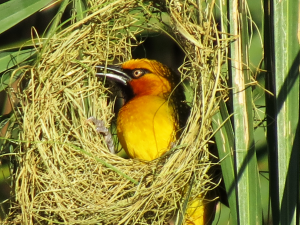
Spectacled Weaver male
Spectacled Weaver female
| Identification. The Spectacled Weaver Ploceus ocularis is named after the black line running through its eye.Unlike many other weaver species, Spectacled Weavers have the same bright yellow plumage year round. Sexes are similar but the female lacks the black bib of the male (above). The juvenile has a pinkish bill, without the eye-stripe initially but can be distinguished from other weavers by its thin bill. See a photo of the female in this pdf on eye colours here (821 kB). The western race of the Black-necked Weaver (see photo birdpix 1064) is very similar in plumage, and the two species overlap in range in Cameroon.
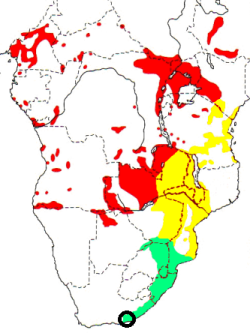
Distribution and plumage of subspecies. Three subspecies of the Spectacled Weaver are currently recognised (see map above, based on Birds of Africa):
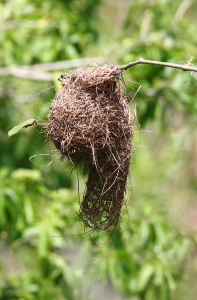
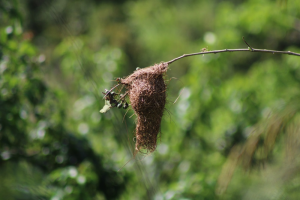
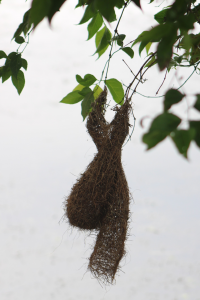
Habitat. The Spectacled Weaver is found in open woodland, forest margins, bushy thickets, wooded valleys, along riverine woodland, savanna with sparse trees, and gardens. Food. The Spectacled Weaver is mainly insectivorous, including crickets, moth caterpillars, beetle larvae; also spiders, centipedes, small crabs; geckos 3 cm long; berries; whole flowers; and nectar. The typical call while feeding is a characteristic descending series of whistles,’tee-tee-tee-tee”.  Breeding. The Spectacled Weaver is a solitary species, probably a permanent pair bond, and pairs often nest at the same site every year. Sometimes nests from previous seasons hang near new nests. The nest is usually built by the male but sometimes the female helps. Unlike polygynous weavers which often build a nest in a day or two, the Spectacled Weaver may take 2-3 weeks to complete its nest. The entrance tunnel is usually 10-20 cm long but may be more than 60 cm long. Nest height varies from 1-7 m above the ground. Egg laying may be as long as two months after the nest is completed. Sometimes a pair will raise two broods in a season – the same nest or a new nest may be used. Beryl Fraser submitted a great sequence of photos of a Spectacled Weaver pair that raised two broods in the same nest. It is an occasional host of the Diederik Cuckoo Chrysococcyx caprius. The oldest Spectacled Weaver to date was a female recaptured several times up to 12 years 7.5 months later (see here). |
The above is based on Weaver Wednesday, a weekly series about weaver species.
This species text first appeared as Weaver Wednesday [24]: Spectacled Weaver on 2012-11-28
2. Breeding facts
| Pair bond Monogamous, with long-term pair-bond Breeding season Nest site Nest building Colony size Clutch size Egg colour Egg size Incubation Chicks and nestling period |
Breeding information based on Handbook of the Birds of the World, Vol. 15.
3. Photos of Weaver Nests
 Vm 29307 |
 Vm 29263 |
 Vm 29242 |
 Vm 29228 |
 Vm 29205 |
 Vm 29197 |
Thumb-nails of recent PHOWN records
[updated 16/10/2023]