
Weaver species list / RELATED SPECIES: Bar-winged Weaver / Brown-capped Weaver / Dark-backed Weaver / Golden-naped Weaver / Maxwell’s Black Weaver / Olive-headed Weaver / Preuss’s Weaver / Red-bellied Malimbe / Red-headed Malimbe / Red-headed Weaver / Usambara Weaver / Yellow-capped Weaver / Yellow-legged Weaver / Yellow-mantled Weaver
IUCN: Least concern Discovery: 054
Categories: long tube, acacias, fruit, gum, baobab, nectar, Nest use, palm, double nests, Anaplectes, blue eggs
SPLIT – Red Weaver Anaplectes jubaensis
(see AviList 2025)
Discovery
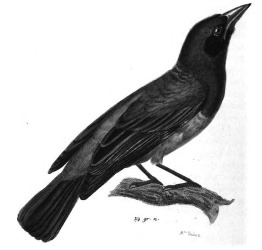 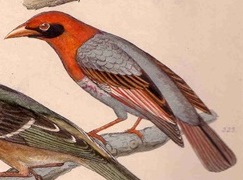 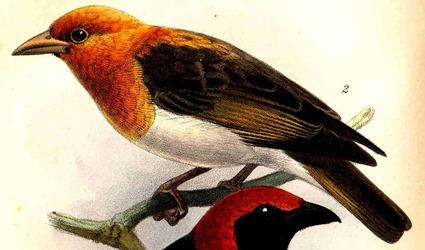 
IntroductionThe Red-headed Weaver was formally described by Carl Jakob Sundevall, a Swedish zoologist employed at the Swedish Museum of Natural History, Stockholm. He described many new birds collected in southern Africa by Johan August Wahlberg and sent to the Swedish Museum.The Red-headed Weaver was collected by Johan August Wahlberg, a Swedish naturalist and explorer. Wahlberg collected at least 5 specimens of the Red-headed Weaver in Oct-Nov 1843 while hunting for big game around Mohapoani – these mountains are now known as the Witfonteinrant Mountains, SW of Thabazimbi in Limpopo Province. Wahlberg travelled in southern Africa between 1838 and 1856, sending thousands of natural history specimens back to Sweden, and several birds and animals were named after him. He was killed by an elephant he wounded while exploring the Okavango area in Botswana. Wahlberg did not collect the first Red-headed Weaver specimens. Two specimens were collected in Senegal by an unknown collector by 1839 and sent to paris where they were described as a new species by Frederic de Lafresnaye in 1839. The name used was invalid, however, and thus Ploceus melanotis became a subspecies. Read more here. The first illustration of a Red-headed Weaver is by Lafresnaye 1839, followed by a colour painting published by Reichenbach 1863 – these both featured the northern subspecies, thought to be the nominate form at the time. The first illustration of the southern African race was published in Elliot (1876). Scientific citationPloceus (Hyphantornis) rubriceps Sundevall 1850 Oefv. K. Sv. Vet.-Akad. Forhandl., vol. vii, p.97 ‘Caffraria superiore’; type from Mohapoani, Rustenberg district, W Transvaal (Gyldenstolpe, 1927, Ark. Zool. vol. 19A(1), p.12). Meaning of namesrubriceps – Latin: ruber, red; -ceps, headed. First English nameThe black-eared Coucou-Weawer; The red-headed Coucou-Weawer (Reichenbach 1863). Alternate namesAyres’s Weaver, Black-eared Scarlet Weaver, Gurney’s Weaver Bird, Jubaland Anaplectes, Masked Red Weaver, Red Winged Anaplectes, Red winged Weaver, Scarlet-headed-Weaver, Yellow-winged Anaplectes. CollectorJohan August Wahlberg. Date collectedOct-Nov 1843. Locality collectedaround Mohapoani = Witfonteinrant Mts, SW of Thabazimbi in Limpopo Province. Type specimensThree type specimens are in the Swedish Museum of Natural History and photos and details are on the web: NRM 568683, NRM 568684, and NRM 568685. |
The above is based on Weaver Wednesday 2, a weekly series about the discovery of each weaver species.
This species text first appeared as Weaver Wednesday [171] – Discovery [54]: Red-headed Weaver on 2015-09-23
1. Basic biology
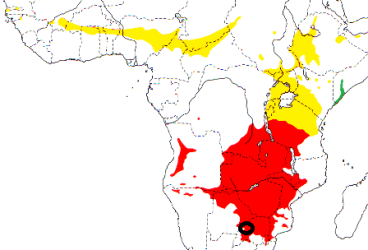
   Identification. The Red-headed Weaver Anaplectes rubriceps, a striking weaver bird with bright red head in the breeding plumage of males. In West and East Africa the male has a black mask; one race in East Africa has a red plumage. The female is yellowish or brownish. Both sexes have a distinctive thin pinkish orange bill. Distribution. This species is one of a handful of weavers that is widespread on the African continent, being found in woodland in West, East, central and southern Africa (see map above, based on Birds of Africa). In northern South Africa it is present at a low density. Many subspecies have been described and 3 are currently recognised. A. r. leuconotos is found in Mali, Burkina Faso and Ghana east to Nigeria, Cameroon, Chad, Central African Republic, Sudan and Ethiopia, also in DRCongo, Uganda, Kenya and Tanzania (yellow on map). The male of this race has a black mask around the eye; both sexes have the margins of the remiges, wing-coverts and rectrices red, not yellow. Habitat. The Red-headed Weaver inhabits broad-leaved woodland, bushveld, miombo and acacia savanna in subtropical to tropical moist regions. It is also found in gardens, especially on farms. Local movements between habitats occur seasonally in Botswana when some of its preferred deciduous habitat becomes inhospitable during the dry season. Food. The Red-headed Weaver feeds mainly on insects, including beetles, grasshoppers, mantids, Hemiptera bugs, and termites. It also feeds on spiders (e.g. social spiders Stegodyphus), fruit (e.g. mistletoe and figs), seeds, and snails. The young are fed on insects and spiders. The Red-headed Weaver is usually solitary or in pairs, but also joins mixed bird parties for feeding. It forages mainly in trees, bushes and creepers among foliage, on dry fruit capsules and along branches, often hanging upside down. The foraging height in trees is 7.9 m high on average. It pecks at spider nests to extract spiders; and hawks insects in the air. Breeding. The Red-headed Weaver is polygynous, and sometimes monogamous. It has a distinctive nest that is constructed of flexible twigs, leaf petioles and tendrils (rather than green grass as in most Ploceus weavers). Several nests may be present at one site, consisting of nests of previous breeding seasons. Sometimes it is colonial, and large colonies have occasionally been reported (see report about largest colony here).   Nests are usually built in trees, including baobabs. This species often builds its nests on man-made structures, including telephone lines and the roof edges of buildings. Old nests are often left hanging and may be used for breeding by other birds, especially Cut-throat Finches. Nests are often associated with raptor nests. Incubation of the blue eggs is by both sexes, mostly by the female. The young are fed by both adults. The Red-headed Weaver is an occasional host to the Diederik Cuckoo (Chrysococcyx caprius). |
The above is based on Weaver Wednesday, a weekly series about weaver species.
This species text first appeared as Weaver Wednesday [1]: Red-headed Weaver on 2012-06-20
2. Breeding facts
| Pair bond Generally polygynous, but some solitary monogamous pairs Breeding season Nest site Nest building Colony size Clutch size Egg colour Egg size Incubation Chicks and nestling period |
Breeding information based on Handbook of the Birds of the World, Vol. 15.
3. Photos of Weaver Nests
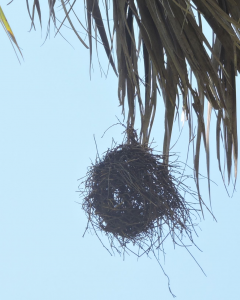 Vm 29289 |
 Vm 29231 |
 Vm 29224 |
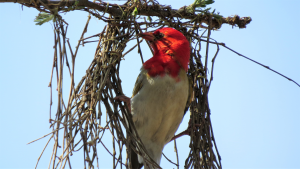 Vm 29204 |
 Vm 29203 |
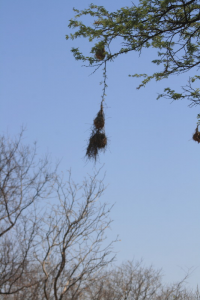 Vm 29084 |
Thumb-nails of recent PHOWN records