
Weaver species list / RELATED SPECIES: Bar-winged Weaver / Brown-capped Weaver / Dark-backed Weaver / Golden-naped Weaver / Maxwell’s Black Weaver / Olive-headed Weaver / Preuss’s Weaver / Red-bellied Malimbe / Red-headed Malimbe / Red-headed Weaver / Usambara Weaver / Yellow-capped Weaver / Yellow-legged Weaver / Yellow-mantled Weaver
IUCN: Least concern Discovery: 092
Categories: nuthatch, fruit
Discovery
 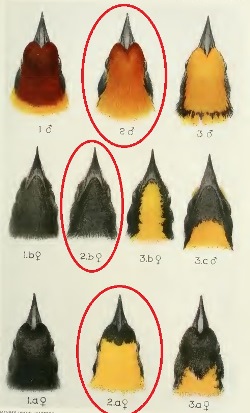 1. Brown-capped Weaver 3. Yellow-capped Weaver Middle row – chins, rest crowns. figure from Ogilvie-Grant (1917) 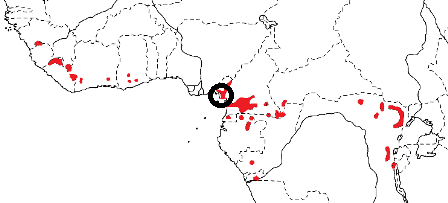
IntroductionThe Preuss’s Weaver was formally described by Anton Reichenow, a German ornithologist and herpetologist.The Preuss’s Weaver was collected by Paul Preuss, a German botanist and collector (born in Prussia). Preuss lived in Sierra Leone from 1886-1888, and then was sent to help in the Zintgraff military expedition to Kumba, western Cameroon in 1889-1892, as most of Cameroon was a German colony. The troop commander was killed in action, so Preuss took charge and led the troops back to the coast. In Victoria (now called Limbe), on the southern slopes of Mount Cameroon, Preuss had time to collect plants and some birds, including Preuss’s Weaver. His specimens were sent to Berlin where Reichenow described the new birds. Preuss founded the botanical garden at Victoria in 1901, and he served as first director until 1902. Preuss collected two male specimens but these were not illustrated. The first illustration of Preuss’s Weaver was of a juvenile, published by Sjostedt (1895). The next illustration was of the heads of this species in Ogilvie-Grant (1917), who compared the species with other similar species. Scientific citationSymplectes preussi Reichenow 1892c, Journ. f. Orn., 40, p.442, Victoria, Cameroon. Meaning of namespreussi, Named after Paul Preuss (1861-1926), a German botanist and collector in West Africa, 1886-1888, 1892-1898 and New Guinea, 1903. First English nameGolden Black-winged Weaver (Shelley 1905b). Alternate namesCongo Golden-backed Weaver, Golden Black-winged Weaver, Golden-backed Weaver, Golden-capped Weaver, Golden-mantle Weaver. CollectorPaul Preuss. Date collected12 May 1892. Locality collectedLimbe (previously Victoria), Cameroon. Type specimensThe type is in the Berlin Museum (ZMB_29953). |
The above is based on Weaver Wednesday 2, a weekly series about the discovery of each weaver species.
This species text first appeared as Weaver Wednesday [209] – Discovery [92]: Preuss’s Weaver on 2016-06-15
1. Basic biology
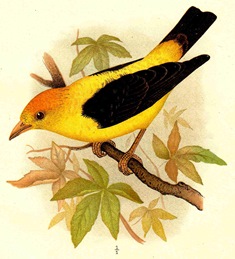
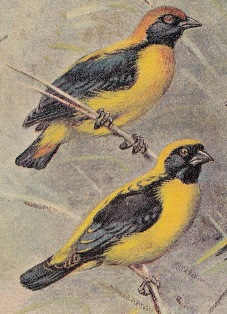 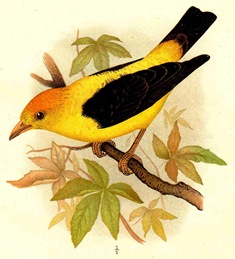 Identification. The Preuss’s Weaver is a small ‘nuthatch weaver’. The male has a black mask with an orange crown and forehead. The male differs from the very similar Brown-capped Weaver by its chestnut forehead merging gradually into yellow on the nape and it has a chestnut patch (instead of yellow) on the lower throat. The Preuss’s Weaver male differs from the Yellow-capped Weaver in having a yellow (not black) rump. The female Preuss’s Weaver has a black mask and band across the forehead, with the rest of the crown yellow, while the Brown-capped Weaver and Yellow-capped Weaver females both have black crowns. The juvenile Preuss’s Weaver has a yellow-olive head and pale bill. Distribution. The Preuss’s Weaver occurs in West and central Africa, from Guinea to DRCongo (see map above, based on Birds of Africa). No races are currently recognised. Its distribution is very patchy, since its forest habitat is fragmented and reduced throughout its range. Habitat. The Preuss’s Weaver inhabits the canopy of primary and secondary forests. It occurs alongside the Red-headed Malimbe in Liberia, foraging in a similar manner, and with the Yellow-capped Weaver in Cameroon. Adults are usually found in pairs, or in groups of 1-4 birds which may be family parties, and in mixed-species flocks. Food. The Preuss’s Weaver feeds mainly on insects, including eggs and larvae, grasshoppers and caterpillars. It also feeds on spiders and other bark-living arthropods. Hard seeds, perhaps from a berry, and a large earthworm have also recorded in its diet. The Preuss’s Weaver runs along branches covered in epiphytes, gleaning on alternate sides, and hangs upside down on occasion. It also forages on boles of forest trees, and on dead trees. Breeding. The Preuss’s Weaver is monogamous and a solitary breeder. Only one nest has been described, as a ball made almost entirely of greyish green Usnea. The nest was bound together with strips of palm leaves. The nest entrance is below, without a tunnel. The nest was fastened securely to small branches, 11 m high in a small tree. The eggs have not been described. Both parents feed the nestlings. |
The above is based on Weaver Wednesday, a weekly series about weaver species.
This species text first appeared as Weaver Wednesday [93]: Preuss’s Weaver on 2014-03-26
2. Breeding facts
| Pair bond Monogamous Breeding season Nest site Nest building Colony size Clutch size Egg colour Egg size Incubation Chicks and nestling period |
Breeding information based on Handbook of the Birds of the World, Vol. 15.
3. Photos of Weaver Nests
No records yet – be the first to submit a PHOWN record!