
Weaver species list / RELATED SPECIES: Bates’s Weaver / Blue-billed Malimbe / Cassin’s Malimbe / Crested Malimbe / Gola Malimbe / Ibadan Malimbe / Rachel’s Malimbe / Red-crowned Malimbe / Red-vented Malimbe / Sao Tome Weaver
IUCN: Least concern Discovery: 022
Categories: Malimbus, fruit, palm
Discovery
 figure from Daudin 1802 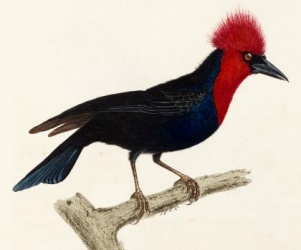
IntroductionThe Crested Malimbe was formally described by Francois Marie Daudin, a young French zoologist. Daudin described a male and female, and included an illustration with the description. The birds had been collected by Jean Perrein, a French naturalist, who travelled in Africa and on other continents. Daudin included brief notes on the nest and eggs of this malimbe, based on the field notes of Perrein. The birds were noted in fig trees near Malimbe.Malimbe, now called Malembo, is located in Cabinda, Angola. The Crested Malimbe is the first malimbe species to be described, and the genus comes from the town name Malimbe. Perrein sent his specimens to Academy of Sciences in Bordeaux, France. The first colour illustrations were provided by Louis Jean Pierre Vieillot, a French ornithologist, who illustrated a male and female. Vieillot provided a different scientific name, but probably saw the same specimens. Scientific citationTanagra malimbica Daudin 1802 Ann. Mus. Paris, I, p.151, pl. 10, fig. 1 Malimbe [Portuguese Congo] Meaning of namesmalimbica After the town of Malimbe, Portuguese Congo (Cabinda), Angola. First English nameCrimson-crowned Finch (Shaw 1816) Alternate names(Congo) Crested Weaver, Gold Coast Crested Weaver, Malimbic Tanager, Upper Guinea Crested Malimbe. CollectorJean Perrein. Date collectedBefore 1802. Locality collectedMalimbe =Malembo, Cabinda, Angola. Type specimensType specimen not traced (it may be in Bordeaux); the illustration of Daudin 1802 serves as a type. |
The above is based on Weaver Wednesday 2, a weekly series about the discovery of each weaver species.
This species text first appeared as Weaver Wednesday [139] – Discovery [22]: Crested Malimbe on 2015-02-11
1. Basic biology
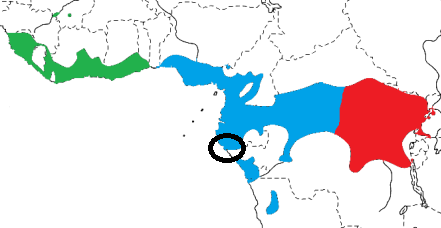
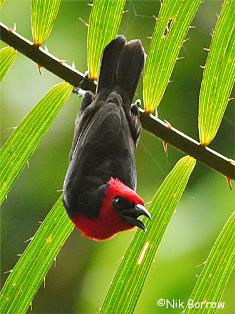 race malimbicus, by Nik Borrow 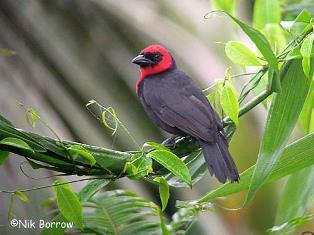 photographer Nik Borrow Identification. The Crested Malimbe Malimbus malimbicus is a common and distinctive malimbe in West Africa. It is the only malimbe with a crest and with a mainly red face and small black face. The female is similar to the male but has a shorter crest. The juvenile is sooty brown above, grey-brown below, and the red is replaced by brownish orange. Distribution. Three races are recognised (see map above, based on Birds of Africa): Habitat. The Crested Malimbe inhabits primary and secondary lowland forest, forest disturbed by logging, and also swamp forest, gallery forest and coffee forest. It is usually found near palms. The Crested Malimbe keeps mainly to the middle strata, searching in foliage and on thin twigs, keeping mostly to the inner parts of the understorey canopy and in dense clusters of lianas. It sometimes visits clearings and road edges. The Crested Malimbe usually occurs singly or in pairs, rarely in small flocks, and it sometimes joins mixed-species foraging flocks. It roosts in its nests at night, and by day is usually found near its nests throughout the year. Food. The Crested Malimbe feeds mainly on insects, including beetles, grasshoppers (up to c. 70 mm long), insect eggs, cicadas, caterpillars. It also feeds on oil-palm fruit fibres and spiders. 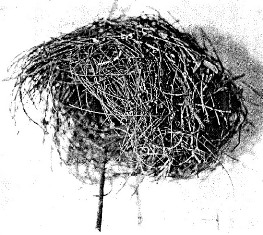 Breeding. The Crested Malimbe is a monogamous, solitary nester. The nest is a compact, globular mass of woven thin strips torn from fronds and stems of palms. the nest strips are short, dry and spiky and stick out at all angles from the nest. The entrance is below, with a very short and ragged entrance tube. The inside of the nest remains dry even during heavy rain. Nests are often in climbing palms, fixed at the tip of the palm frond. A pair may build 3 nests at the same time. Many nests are abandoned, or used only for roosting. The male chooses a nest site and starts building by making a ring of leaf strips that are firmly attached below a palm midrib. The female follows the male, and then helps build from the ring stage. A nest can be completed in a single day. At one nest a male made 80 trips and the female 35 visits in 4 hours, bringing material every time. The female incubates the eggs. The male remains near the nest, maintaining contact with female with special calls. There is one record of brood parasitism by a Diederik Cuckoo Chrysococcyx caprius. View video of Crested Malimbe building nest at Internet Bird Collection. |

The above is based on Weaver Wednesday, a weekly series about weaver species.
This species text first appeared as Weaver Wednesday [100]: Crested Malimbe on 2014-05-14
2. Breeding facts
| Pair bond Monogamous Breeding season Nest site Nest building Colony size Clutch size Egg colour Egg size Incubation Chicks and nestling period |
Breeding information based on Handbook of the Birds of the World, Vol. 15.
3. Photos of Weaver Nests
 Vm 27825 |
Thumb-nails of recent PHOWN records