
Weaver species list / RELATED SPECIES: Bates’s Weaver / Blue-billed Malimbe / Cassin’s Malimbe / Crested Malimbe / Gola Malimbe / Ibadan Malimbe / Rachel’s Malimbe / Red-crowned Malimbe / Red-vented Malimbe / Sao Tome Weaver
IUCN: Least concern Discovery: 060
Categories: long tube, black, white eggs, cooperative, Malimbus, fruit, palm
Discovery
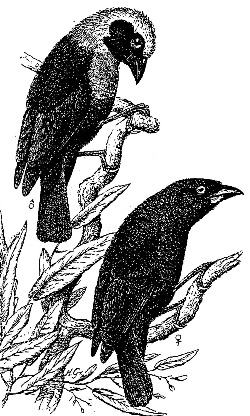 
IntroductionCassin’s Malimbe was formally described by Daniel Giraud Elliot, an American zoologist. Elliot named this species after John Cassin, an American ornithologist and curator of the Academy of Natural Sciences of Philadelphia (ANSP), now Academy of Natural Sciences of Drexel University.Cassin’s Malimbe had been collected for and purchased by one of the Verreaux brothers. It had been collected in Gabon in May 1859. One of the active collectors there was Paul Belloni Du Chaillu, a French-American traveler, zoologist, and anthropologist. Du Chaillu explored West Africa from 1855-59 near the equator, especially around Gabon, so he is the likely collector. Only the male was described initially, and the female was described many years later. The first illustration was of a male Cassin’s Malimbe by Elliot (1876), a few years after he described the species. The next illustration was published many decades later by Bannerman (1949), and pictured both male and female, although not in colour. Scientific citationSycobius cassini Elliot 1859, Ibis, 1859, p.392 Gabon. Meaning of namescassini – After John Cassin (1813-1869) US ornithologist, who described several weaver species. First English nameBlack-throated Malimbe (Sclater 1930), decades after it was first described. Alternate namesBlack-throated Malimbe. Collectorvia the Verreaux business, possibly collected by Du Chaillu. Date collectedMay 1859. Locality collectedGabon. Type specimensThe type specimen is in the British Museum (BM 1859.6.28.12). |
The above is based on Weaver Wednesday 2, a weekly series about the discovery of each weaver species.
This species text first appeared as Weaver Wednesday [177] – Discovery [60]: Cassin’s Malimbe on 2015-11-04
1. Basic biology
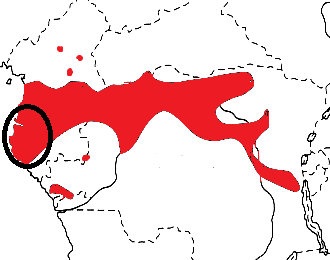
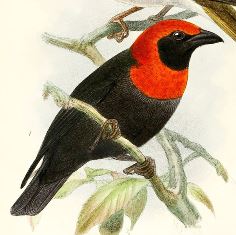 Identification. Cassin’s Malimbe is red and black in the male and all black in the female. The male has a black face surrounded by a red head, collar and breast – it is similar to the Red-vented Malimbe but has a black vent. The female Cassin’s Malimbe resembles the black Maxwell’s Black Weaver and male Vieillot’s Black Weaver but the eye is dark, the bill is shorter and more slender, and the feet dark in the malimbe. Cassin’s Malimbe is almost indistinguishable from the female Red-crowned Malimbe, and it is best to see both male and female together to confirm identification. The immature Cassin’s Malimbe has a pale red or orange head. Distribution. Cassin’s Malimbe occurs in Cameroon, Central African Republic, Equatorial Guinea, Gabon, PRCongo, and DRCongo along major rivers (see map above, based on Birds of Africa). There are no subspecies. Habitat. Cassin’s Malimbe inhabits dense, tall primary forest, often in swampy areas or in forest areas that are prone to seasonal flooding near watercourses. It is associated with wine palms, oil palms and climbing rattan palms. Food. Cassin’s Malimbe feeds mainly on insects, including crickets and grasshoppers, mantids and moths. It has been seen feeding on fruits of the oil palm in PRCongo. It forages in pairs or small groups at middle levels and in the canopy, but may also venture into more open areas. Cassin’s Malimbe regularly joins mixed-species flocks. Breeding. Cassin’s Malimbe is apparently monogamous. Nest-building is initially co-operative, often with one female and several males building simultaneously. The dominant male then displaces the other birds, and remains with a female. Nest construction takes up to 15 days. The nest is very distinctive, and considered to have the most regular weaver of all weaver nests. The nest has a very long, transparent tunnel that hangs vertically downwards (up to 1 m). 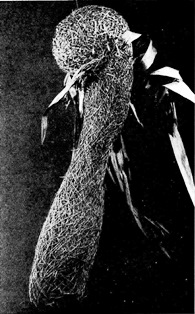 The nest is finely woven from stiff material. The egg-chamber is lined with green palm strips, woven in several layers of short, broad strips of material. The tunnel is woven of one layer of fine, long strips from palm fronds, with fibres projecting loosely at the end of the tube. The nest is attached 10-25 m above the ground in climbing palms or other trees. The female strips the leaves around the nest. Nests may persist for several seasons, and thus several may be seen close together, although only the newest nest appears to be used for breeding; old nests may be used for roosting. The clutch is 2 eggs, which are pure white (few weaver species lay only white eggs). Incubation is by both sexes, with incubation bouts of nearly 1 hour at a time. The chicks are fed by both sexes. In a Gabon study, most nests were robbed by chimpanzees Pan troglodytes. |
The above is based on Weaver Wednesday, a weekly series about weaver species.
This species text first appeared as Weaver Wednesday [108]: Cassin’s Malimbe on 2014-07-09
2. Breeding facts
| Pair bond Apparently monogamous Breeding season Nest site Nest building Colony size Clutch size Egg colour Egg size Incubation Chicks and nestling period |
Breeding information based on Handbook of the Birds of the World, Vol. 15.
3. Photos of Weaver Nests
No records yet – be the first to submit a PHOWN record!