
Weaver species list / RELATED SPECIES: Compact Weaver / Cardinal Quelea / Red-billed Quelea / Red-headed Quelea
IUCN: Least concern Discovery: 078
Categories: Quelea, nectar, pest
Discovery
 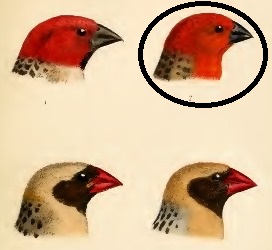 
IntroductionThe Cardinal Quelea was formally described by Karel Johan Gustav Hartlaub, a German physician and ornithologist. Hartlaub described several other weavers.The Cardinal Quelea was collected by Emin Pasha, a Ottoman-German physician, naturalist, and governor of the Egyptian province of Equatoria on the upper Nile. He collected a large number of birds in Uganda and Sudan. Emin collected a large number of male and female Cardinal Queleas around Lado in July to August 1879. The specimens were sent to Germany and through exchanges there are syntypes in various museums, including Berlin, Bremen, Bristish Museum and the American Museum of Natural History. Emin’s diaries have been published, and he wrote a little over a page about the Cardinal Quelea. He noted that water was important and flocks flew to drink in the mornings and evenings. While drinking, birds also fed on insects, while they fed on grass seeds during the day. Emin also found nesting colonies in trees and noted the clutch size as 2-4. The first illustration of the Cardinal Quelea was of the type, but published in the year following the description. The second illustration for the species was published by Sharpe (1890), also showing the two previously described quelea species. Scientific citationHyphantica cardinalis Hartlaub 1880, Journ. f. Orn., 28, p.325 Lado, southern Sudan. Meaning of namescardinalis, Med. Latin: cardinalis, a cardinal, a senior bishop of the Roman church who wears scarlet robes. First English nameCardinal Dioch (Shelley 1905). Alternate namesCardinal Weaver Finch, Red-bib Quelea. CollectorEmin Pasha. Date collectedJuly to August 1879. Locality collectedLado, South Sudan. Type specimensThere are syntypes in various museums, including Berlin, Bremen, Bristish Museum and the American Museum of Natural History. |
The above is based on Weaver Wednesday 2, a weekly series about the discovery of each weaver species.
This species text first appeared as Weaver Wednesday [195] – Discovery [78]: Cardinal Quelea on 2016-03-09
1. Basic biology
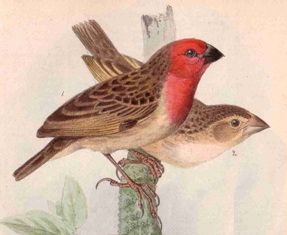 Identification. The Cardinal Quelea is a small bird with a short stubby bill. The male in breeding plumage is separated from the similar Red-headed Quelea Q. erythrops by the red of the head extending onto the breast but not onto the streaked nape. The female has a yellowish face and superciliary stripes, and is told from the female Red-headed Quelea by a smaller, darker bill, and yellowish throat, but is probably not separable in the field. The non-breeding male resembles the female but has some red on its head. The Red-billed Quelea Q. quelea differs in having a red or yellow bill. Distribution. The Cardinal Quelea occurs in South Sudan, north-eastern DRCongo, Uganda, western Kenya, Tanzania and eastern Zambia (see map above, based on Birds of Africa). No subspecies are currently recognised, although some have been proposed. Habitat. The Cardinal Quelea inhabits rank grass or tall wooded grassland, especially in dry areas rather than marshes. It is ecologically intermediate between the Red-billed Quelea which inhabits relatively arid country, and the Red-headed Quelea which occurs in high rainfall areas. It often appears after rains, especially in normally drier regions. The Cardinal Quelea is highly gregarious, often being found in large flocks but also in smaller groups. Large flocks break up into smaller groups when breeding begins. Food. The Cardinal Quelea forages on the ground, feeding on seeds, especially grass seeds, but also takes nectar. It is a pest of agricultural crops in some parts of its range. The nestlings are fed on insects, especially caterpillars, and regurgitated seeds. 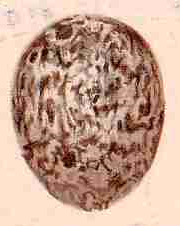 figure from Ogilvie-Grant 1912 Breeding. The Cardinal Quelea is polygynous. Colony size varies from large, dense colonies to small groups of nests, to sometimes solitary nests. Colonies of several hundred nests may form in areas where they were previously unknown. The nest is a domed structure, tightly woven of grass, with a large side entrance, and no porch. It is lined with finer grass. The nest is placed between the vertical stems of grass or other vegetation, or is rarely attached to the branches of a shrub. The male builds the nest, and may complete in a day, although some nests are abndoned before completion. If a female accepts a nest, the male may construct another nest as a roost site. 2-4 eggs are laid, and they are whitish, blue or greenish and finely spotted or mottled with reddish brown or greyish mauve. Nests may be parasitized by the Diederik Cuckoo Chrysococcyx caprius. |

The above is based on Weaver Wednesday, a weekly series about weaver species.
This species text first appeared as Weaver Wednesday [76]: Cardinal Quelea on 2013-11-27
2. Breeding facts
| Pair bond Polygynous. Colonial Breeding season Nest site Nest building Colony size Clutch size Egg colour Egg size Incubation Chicks and nestling period |
Breeding information based on Handbook of the Birds of the World, Vol. 15.
3. Photos of Weaver Nests
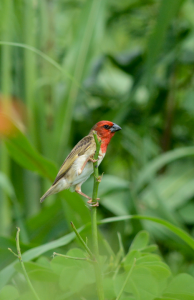 Vm 9894 |
Thumb-nails of recent PHOWN records