
Weaver species list / RELATED SPECIES: Bates’s Weaver / Blue-billed Malimbe / Cassin’s Malimbe / Crested Malimbe / Gola Malimbe / Ibadan Malimbe / Rachel’s Malimbe / Red-crowned Malimbe / Red-vented Malimbe / Sao Tome Weaver
IUCN: Least concern Discovery: 035
Categories: Malimbus, fruit, palm
Discovery
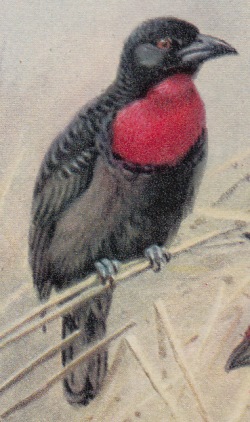
IntroductionThe Blue-billed Malimbe was formally described by George Robert Gray, an English zoologist, author, and head of the ornithological section of the British Museum. Gray started at the British Museum as Assistant Keeper of the Zoology Branch in 1831, when he would have found the specimen brought to the museum years earlier.The Blue-billed Malimbe had been collected by Captain Edward Sabine, an Irish astronomer, geophysicist, ornithologist, explorer, and soldier. Sabine travelled halfway around the world to study the the “oblateness” (shape) of the Earth and carried out measurements on the intertropical coasts of Africa and the Americas. Sabine had struck up a friendship with Douglas Clavering, an officer of the British Royal Navy, who agreed to take Sabine on board the Pheasant. They travelled to Sierra Leone, the Island of St Thomas, Ascension Island, Bahia, Maranham, Trinidad, Jamaica, and New York during the years 1821-23. The first illustration of a Blue-billed Malimbe is in Gray (1849), although it is a poor illustration (the original may be in colour, the internet scanned version is not). The next potential illustration is by Reichenbach (1863), who illustrated most weavers known at that time – he described 3 malimbes but the paintings of these species do not appear to have been published. This species was not illustrated again until Bannerman (1949). Scientific citationPloceus nitens Gray 1831; Zool. Misc., 1, p.7; Sierra Leone (cf. Sharpe, 1890, Cat. Birds Brit. Mus., 13, p.481). Meaning of namesnitens Latin: shining, glittering (nitere, to shine). First English nameRed-breasted Weaver (Gray 1831). Alternate namesRed-breasted Weaver, The shining Malimbus, Lake Albert Malimbe, Gray’s Blue-billed Weaver, Great Blue-billed Weaver. CollectorCaptain Edward Sabine. Date collectedBetween 1821 – 1823. Locality collectedSierra Leone. Type specimensOne type specimen is in the British Museum (BM Old Vellum Cat. 21 no. 82a). |
The above is based on Weaver Wednesday 2, a weekly series about the discovery of each weaver species.
This species text first appeared as Weaver Wednesday [152] – Discovery [35]: Blue-billed Malimbe on 2015-05-13
1. Basic biology
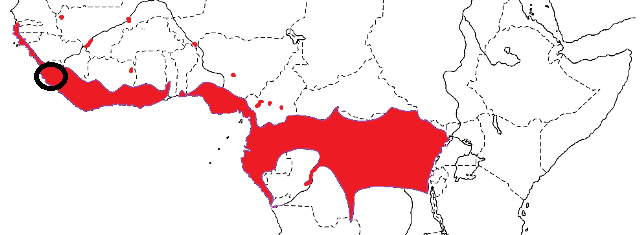
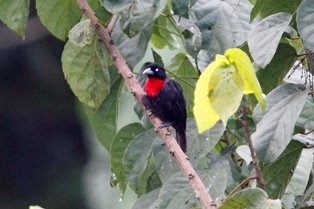 Identification. The Blue-billed Malimbe Malimbus nitens is black with a scarlet patch on the throat and upper breast (photo right, enlarged from phown 984). The blue bill is slightly curved. The female is similar to the male but is slightly duller, and the immature bird is browner with a dull orange patch.Distribution. The Blue-billed Malimbe is found from Senegal to western Uganda and northern Angola, as shown in the map (below, from Birds of Africa). It has no subspecies, although two were proposed in the past. Habitat. The Blue-billed Malimbe inhabits primary, logged and mature old secondary lowland forest, keeping largely to the undergrowth. It is also found in riverine forest and dense thickets near water, or in swamp forest. The Blue-billed Malimbe is solitary or found in pairs or family parties.
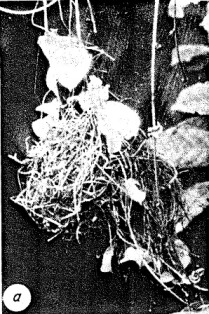 Food. The Blue-billed Malimbe feeds on a wide variety of arthropods, including larvae, grubs, chrysalises, caterpillars, ants, hemipterans, grasshoppers, small beetles, butterflies and spiders. It sometimes feeds on seeds or oil palm fruits. It climbs tree limbs like a woodpecker, while foraging for arthropods. Breeding. This species is monogamous and the male builds a new nest every season. Old nests may survive for several years so that a few nests may be clustered nearby. Sometimes several pairs form loose colonies. The nest is ball-shaped, made of strips of epiphytes, palm fibres, twigs and tendrils (see photo right, from Collias NE, Collias EC. 1964. Evolution of nest building in weaverbirds. Univ. Calif. Publ. Zool. 73:1-239). The nests often overhang forest rivers and ponds. The entrance tunnel is not very long, as in the nests of some malimbes. 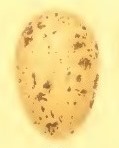 The eggs are pale with darker markings, and incubation is by the female only. A remarkable nesting association has been found in this species. They like to build their nests in the vicinity of dens of the Central African Dwarf Crocodile Osteolaemus tetraspis, presumably because the presence of crocodiles keeps predators away. |
The above is based on Weaver Wednesday, a weekly series about weaver species.
This species text first appeared as Weaver Wednesday [12]: Blue-billed Malimbe on 2012-09-05
2. Breeding facts
| Pair bond Monogamous Breeding season Nest site Nest building Colony size Clutch size Egg colour Egg size Incubation Chicks and nestling period |
Breeding information based on Handbook of the Birds of the World, Vol. 15.
3. Photos of Weaver Nests
 Vm 13823 |
 Vm 5334 |
 Vm 984 |
Thumb-nails of recent PHOWN records