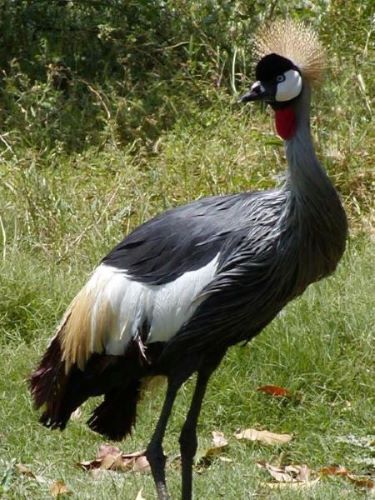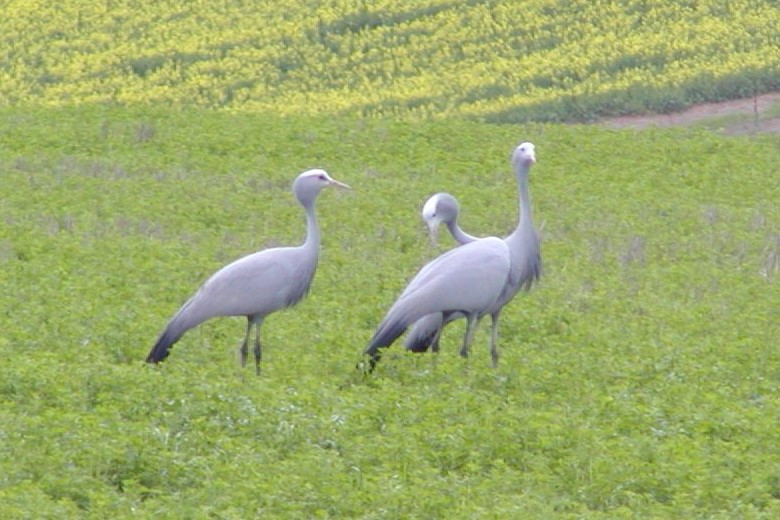
There are 15 species of cranes, found on 5 continents (not South America or Antarctica). The cranes are among most threatened bird families globally, with about ¾ of species listed as threatened.
Cranes are elegant birds, with haunting calls and energetic courtship dances. Cranes are found in a wide variety of open habitats, but most prefer wet areas and grasslands. All cranes fly with their necks stretched out, rather than folded in an S shape like herons. Cranes have long legs, necks and bills. The sexes are similar, but males are a bit larger than females.
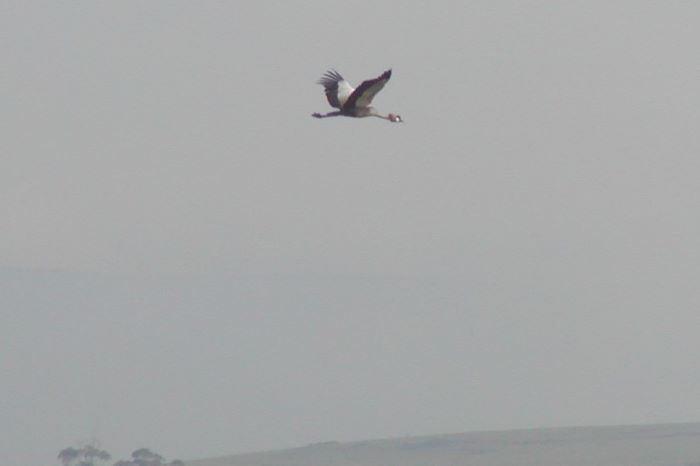
The crane family is divided into two subfamilies, the crowned cranes (Balearicinae) and the “typical” cranes (Gruinae).
Africa has six crane species: Blue Crane Anthropoides paradiseus, Wattled Crane Bugeranus carunculatus, Grey Crowned Crane Balearica regulorum, Black Crowned Crane Balearica pavonina, Demoiselle Crane Anthropoides virgo, and Eurasian Crane Grus grus.
The Blue Crane is the national bird of South Africa (and a near endemic), and the Grey Crowned Crane is the national bird of Uganda. The Wattled Crane is the emblem of BirdWatch Zambia, the BirdLife partner in this country.

Ringing and longevities
Three species of cranes are found in southern Africa. Ringed birds are mostly young birds, or sometimes rehabilitated birds, so the totals are relatively low. Many of the cranes are colour ringed, providing some resighting data. Longevities in captivity indicate that cranes could live several decades in the wild – ringing totals are too low to show comparable records.
Table 1. Ringing stats for crane species, from the SAFRING database (extracted 16 May 2020).
| Sp no | Species | Ringed / resight / recovered | Longevity | Ring no | Age in captivity |
| 214 | Grey Crowned Crane | 149 / 1 / 3 | 7y 0m | 9A31073 | 28 y |
| 215 | Wattled Crane | 177 / 7 / 2 | 10y 9m | J12624 | 45 y |
| 216 | Blue Crane | 1360 / 172 / 62 | 12y 10m | 52503264 | 34 y |